
Many British families eventually reach a point where reconnecting with lost relatives or confirming personal identity becomes more than just curiosity. Understanding what address tracing truly involves is vital, especially when accuracy and privacy are at stake. By uncovering the process beyond a simple search, this guide explains why confidential address tracing demands both technical skill and careful respect for legal protections, helping you avoid common misconceptions and costly mistakes.
Table of Contents
- Address Tracing Meaning And Misconceptions
- Major Types Of Address Tracing In The UK
- How Address Tracing Works Step By Step
- Legal Standards And Confidentiality Safeguards
- Practical Risks And Common Mistakes
Key Takeaways
| Point | Details |
|---|---|
| Complexity of Address Tracing | Address tracing is a sophisticated process that goes beyond simple online searches, requiring multiple data sources and investigative techniques. |
| Legal and Ethical Considerations | It is crucial to ensure compliance with legal frameworks and privacy regulations before conducting address tracing investigations. |
| Methodological Approaches | Various techniques exist for address tracing, each suited for different contexts, requiring various levels of expertise. |
| Risks and Mistakes | Common pitfalls include data misinterpretation and privacy violations, which can lead to legal repercussions if not carefully managed. |
Address tracing meaning and misconceptions
Address tracing represents a sophisticated investigative process far more complex than most people understand. It involves systematically identifying and verifying an individual’s residential or business location through multiple data sources and investigative techniques. Address tracing is not merely about finding someone’s physical address, but encompasses a comprehensive approach to locating and confirming personal information.
The process involves several critical methods and technological approaches:
- Utilising public records databases
- Cross-referencing electoral roll information
- Examining utility registration records
- Accessing historical property ownership documents
- Leveraging digital network tracking protocols
Many individuals misconceive address tracing as a simple online search, but the reality is far more nuanced. Technical network investigation protocols reveal that effective address tracing requires sophisticated understanding of data resolution, privacy regulations, and legal frameworks.
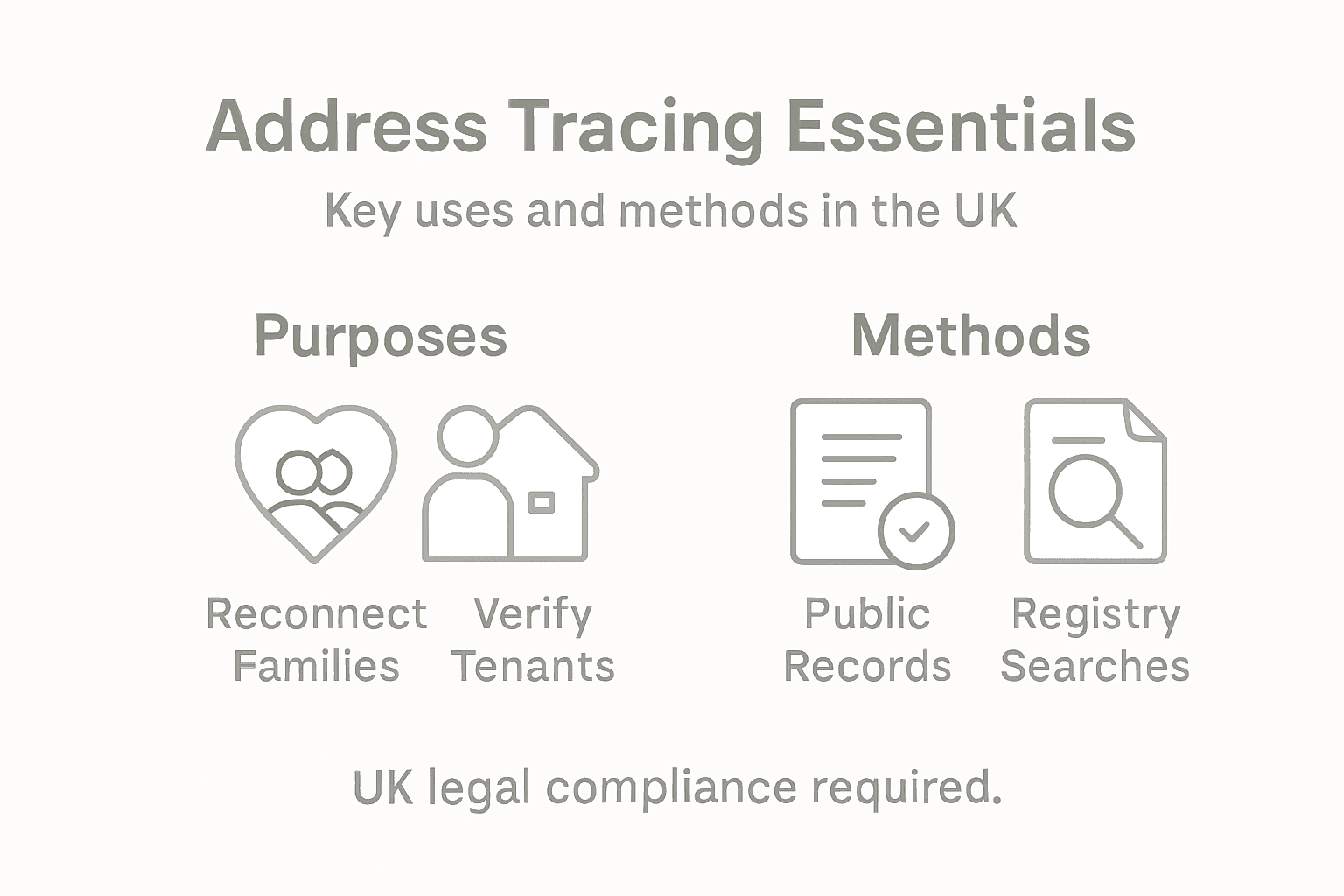
In the United Kingdom, address tracing serves multiple important purposes, including reconnecting lost relatives, verifying individual identities, and supporting legal investigations. Accuracy is paramount in these searches, as incorrect information can lead to significant personal and legal complications.
Pro tip: Always ensure you have legitimate legal grounds and proper authorisation before conducting any address tracing investigation.
Major types of address tracing in the UK
Address tracing in the United Kingdom encompasses several sophisticated methodological approaches designed to locate and verify individual residential information. Address search methods range from traditional investigative techniques to advanced digital tracking protocols, each serving unique purposes and meeting specific informational requirements.
The primary types of address tracing in the UK include:
- Public Records Search: Examining electoral rolls, council tax registers, and government databases
- Utility Registration Tracking: Investigating electricity, water, and telecommunication service registrations
- Land Registry Investigations: Accessing property ownership and historical residence records
- Digital Network Tracing: Utilising online databases and interconnected information systems
- Social Media and Digital Footprint Analysis: Gathering location-related digital information
Each tracing method requires different levels of expertise and access. Some approaches are readily available to the public, while others demand specialised investigative skills or legal authorisation. The complexity of these methods reflects the nuanced nature of personal information retrieval in the modern digital landscape.
Here is a concise overview of the main address tracing methods and their typical uses in the United Kingdom:
| Tracing Method | Primary Use | Required Expertise |
|---|---|---|
| Public Records Search | Legal checks, identity verification | Basic research skills |
| Utility Registration Tracking | Confirm current occupation | Moderate investigation |
| Land Registry Investigations | Historic property tracing | Advanced legal skills |
| Digital Network Tracing | Online activity analysis | Technical proficiency |
| Social Media and Digital Footprint | Locating recent movements | Digital analysis skills |
Accuracy and privacy remain paramount considerations in address tracing. Professional investigators must navigate complex legal frameworks, ensuring that every search respects individual privacy rights and complies with data protection regulations.
Pro tip: Always verify the legal permissions and ethical boundaries before conducting any address tracing investigation.
How address tracing works step by step
Address tracing is a methodical process that requires careful navigation through multiple information sources. Address tracing techniques involve a strategic approach designed to locate and verify residential information with precision and legal compliance.
The comprehensive address tracing process typically follows these systematic steps:
- Initial Information Gathering
- Collect basic known details about the target individual
- Verify the accuracy of initial information sources
- Confirm the specific search parameters
- Database Research
- Access public records and official databases
- Cross-reference electoral roll registrations
- Check utility company registration records
- Digital Verification
- Investigate online digital footprints
- Analyse social media and professional networking platforms
- Validate digital communication traces
- Legal Compliance Check
- Ensure all search methods meet data protection regulations
- Obtain necessary authorisations
- Maintain strict confidentiality protocols
Each stage requires meticulous attention to detail and an understanding of complex information retrieval techniques. Professional address tracers must balance technological capabilities with strict ethical guidelines, ensuring that every search respects individual privacy while delivering accurate results.
The effectiveness of address tracing depends on multiple interconnected factors, including the quality of initial information, access to comprehensive databases, and the investigator’s expertise in navigating complex information systems.
Pro tip: Always document your research process and maintain a clear audit trail to ensure the legitimacy of your address tracing investigation.
Legal standards and confidentiality safeguards
Address tracing in the United Kingdom operates under stringent legal frameworks designed to protect individual privacy and personal data. Data protection regulations establish comprehensive guidelines that govern how personal information can be collected, processed, and utilised by investigative services and individuals.
Key legal standards and confidentiality safeguards include:
-
Consent Requirements
- Explicit permission from the subject
- Clear documentation of investigative purpose
- Transparent data collection methods
-
Data Protection Principles
- Lawful and transparent processing
- Purposeful data collection
- Minimisation of personal information usage
- Ensuring data accuracy and integrity
-
Regulatory Compliance
- Adherence to UK General Data Protection Regulation (UK GDPR)
- Compliance with Data Protection Act 2018
- Strict confidentiality protocols
- Regular data protection audits
Professional address tracing services must navigate a complex landscape of legal obligations. Ethical data handling requires not just technical expertise, but a deep understanding of individual privacy rights and regulatory frameworks. Every search must balance the need for information with the fundamental right to personal privacy.

The consequences of non-compliance can be severe, including significant financial penalties and potential legal action. This underscores the critical importance of maintaining rigorous standards throughout the address tracing process.
Pro tip: Always document your investigative process and maintain a comprehensive audit trail to demonstrate legal compliance and ethical data handling.
Practical risks and common mistakes
Address tracing requires exceptional precision and careful navigation to avoid potential pitfalls that could compromise investigative integrity. Address tracing techniques demand meticulous attention to prevent common errors that might render research ineffective or legally problematic.
Common risks and mistakes in address tracing include:
-
Data Misinterpretation
- Relying on outdated or incorrect information
- Failing to cross-reference multiple sources
- Assuming data accuracy without verification
-
Privacy Violations
- Accessing information without proper authorisation
- Breaching confidentiality protocols
- Mishandling sensitive personal data
-
Technical Errors
- Incomplete search parameters
- Overlooking digital footprint variations
- Misinterpreting network trace results
-
Legal Compliance Issues
- Insufficient documentation
- Neglecting consent requirements
- Inappropriate data storage practices
Each mistake carries significant consequences, ranging from compromised research outcomes to potential legal repercussions. Investigative precision demands a comprehensive understanding of both technological capabilities and legal constraints.
The following table summarises potential address tracing mistakes, their impact, and ways to prevent them:
| Mistake Type | Consequence | Prevention Strategy |
|---|---|---|
| Data Misinterpretation | Misdirected search, wasted effort | Cross-check all information sources |
| Privacy Violation | Legal penalties or complaints | Secure prior consent and authorisation |
| Technical Error | Missed leads, incomplete data | Regular skills and systems review |
| Legal Non-Compliance | Fines or criminal investigation | Strict adherence to UK GDPR rules |
Professional address tracers must develop robust methodological approaches that balance technological efficiency with strict ethical standards. This requires continuous learning, adaptability, and a commitment to maintaining the highest levels of professional integrity.
Pro tip: Develop a systematic checklist for each address tracing investigation to minimise human error and ensure comprehensive, legally compliant research.
Ensure Precision and Confidentiality with Professional Address Tracing Services
Address tracing demands accuracy and strict adherence to legal standards to avoid risks such as incorrect information or privacy violations. If you need to reconnect with lost relatives, verify identities, or obtain reliable address details within the United Kingdom, relying on a trusted specialist is essential. At UKtrace.co.uk, we understand the complexities and challenges highlighted by address tracing methods including public records, utility tracking, and digital footprint analysis.
Explore our tailored solutions for comprehensive Name and address searches UK and delve into precise UK Land and property searches. Our commitment to confidentiality and meticulous verification ensures you obtain credible information every time. Act now to take control of your investigation with professional support at UKtrace.co.uk. Start your search today and experience peace of mind knowing your inquiry is handled with expert care and legal compliance.
Frequently Asked Questions
What is address tracing?
Address tracing is an investigative process used to systematically identify and verify an individual’s residential or business location through various data sources and techniques. It goes beyond simply finding a physical address to confirming personal information.
Why is accuracy important in address tracing?
Accuracy in address tracing is crucial because incorrect information can lead to significant personal and legal complications. Ensuring precise data helps maintain the integrity of the investigation and protects the privacy rights of individuals.
What methods are used in address tracing?
The methods used in address tracing include public records searches, utility registration tracking, land registry investigations, digital network tracing, and analysis of social media activity. Each method serves different purposes and requires varying levels of expertise.
What legal standards govern address tracing?
Address tracing is governed by strict legal frameworks which include consent requirements, data protection principles, and compliance with data protection regulations. Investigators must ensure their methods respect individual privacy and adhere to the law.
Recommended
- Why Trace UK Addresses: Safeguarding Identity and Trust – UK Trace
- Why Trace Addresses: Driving Trust and Reconnection – UK Trace
- How Address Tracing Works—Benefits for UK Research – UK Trace
- Defining UK Tracing Services: Accuracy and Legal Impact – UK Trace
- Account Reconciliation: Boosting Small Business Accuracy