
Searching for relatives in the United Kingdom often means piecing together incomplete address records and old correspondence. For those hoping to reconnect, accurate address tracing makes the difference between finding a lost branch of the family or reaching a dead end. By using verified sources like the Royal Mail’s Postcode Address File, modern tracing services bring confidence and clarity to personal investigations, helping you track down genuine address information with precision.
Table of Contents
- What Address Tracing Involves in the UK
- Key Types of Address Tracing Services
- How the Address Tracing Process Works
- Legal Standards for UK Address Tracing
- Common Pitfalls and Privacy Risks
Key Takeaways
| Point | Details |
|---|---|
| Address Tracing Methodology | UK address tracing involves systematic verification through official records and comprehensive databases, ensuring accuracy. |
| Legal Compliance | Address tracing services must adhere to strict data protection regulations, ensuring transparency and security in data handling. |
| Technological Integration | Geospatial technologies and unique identifiers enhance the accuracy of address verification processes. |
| Privacy Risks | Organizations must implement robust security measures to protect personal data and prevent unauthorized access. |
What Address Tracing Involves in the UK
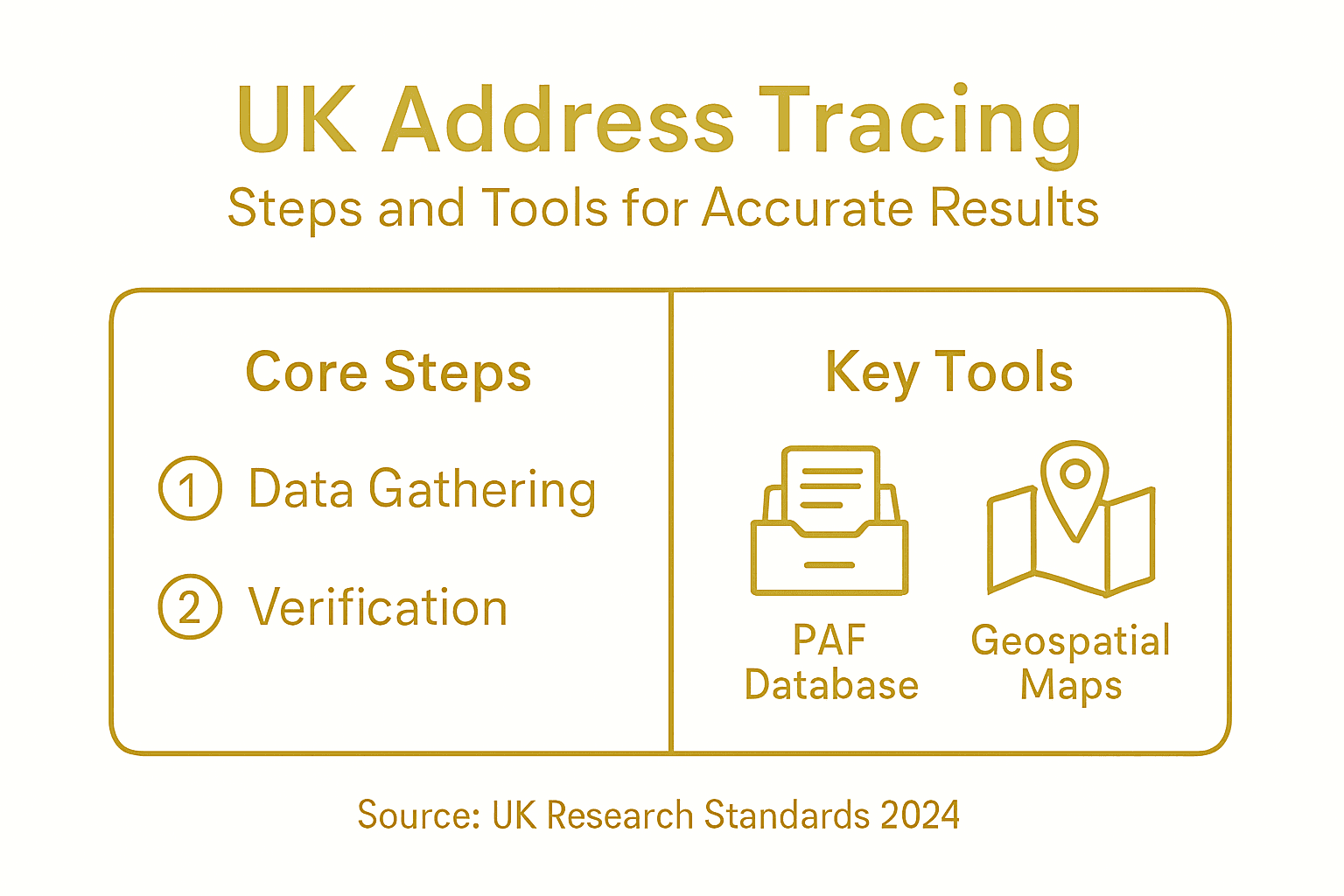
Address tracing in the United Kingdom is a systematic process for locating and verifying residential and business address information through multiple authoritative channels. At its core, the process relies on comprehensive databases like the Postcode Address File, which contains extensive details about delivery points and postcodes nationwide.
The address tracing methodology typically involves several key components:
- Accessing official government records
- Utilizing Royal Mail’s comprehensive address databases
- Cross-referencing multiple identification sources
- Verifying residential and correspondence addresses
Government agencies and specialized tracing services employ sophisticated verification techniques to ensure accuracy. These methods include checking passport applications, cross-referencing multiple databases, and using advanced digital search technologies. Each verification process aims to confirm the precise location and current occupancy of a specific address.
The technical aspects of UK address tracing require careful navigation of legal and privacy regulations. Professionals must follow strict protocols when accessing and using personal address information, ensuring that all searches comply with data protection standards. This means maintaining confidentiality while providing accurate, up-to-date location details for legitimate purposes.
Pro tip: Always request official documentation and maintain clear records when conducting address tracing to ensure legal compliance and accurate results.
Key Types of Address Tracing Services
Address tracing services in the United Kingdom offer diverse methodologies for locating and verifying residential and business addresses. One of the most sophisticated approaches involves using Unique Property Reference Numbers, which provide a standardized system for tracking property locations across multiple databases.
The primary types of address tracing services include:
- Residential address verification
- Business address location services
- Geographic mapping and geospatial tracking
- Public records database searches
- Digital and online address verification platforms
These services leverage multiple data sources to ensure accuracy. Geospatial technologies play a crucial role, with platforms like MapIt enabling precise location identification by mapping postcodes to specific administrative areas. This allows for comprehensive address verification that goes beyond simple name and street matching.
Professional address tracing services employ advanced techniques to cross-reference information. These include accessing government databases, checking electoral rolls, investigating utility records, and utilizing digital tracking technologies. Each method provides a layer of verification, ensuring that the retrieved address information is as current and accurate as possible.

Here’s a summary of the main technologies and databases used in UK address tracing and their purposes:
| Technology/Database | Purpose | Typical Use Case |
|---|---|---|
| Postcode Address File (PAF) | Comprehensive delivery address data | Validating mailing addresses |
| Unique Property Reference Number | Unique property identification | Linking addresses across systems |
| MapIt | Geospatial mapping and area lookup | Locating administrative regions |
| Electoral Roll | Verifies residential occupancy | Tracing individuals |
| Utility Records | Confirms property occupation | Corporate and personal searches |
Pro tip: Always cross-reference multiple address sources to confirm the most up-to-date and accurate location information.
How the Address Tracing Process Works
Address tracing in the United Kingdom follows a meticulous, multi-step approach designed to ensure accuracy and reliability. The process begins with capturing customer address information through various application channels, including online submissions and paper documentation.
The typical address tracing workflow involves several key stages:
- Initial data collection
- Cross-referencing multiple databases
- Verification of residential and business addresses
- Scanning for potential errors
- Confirming location accuracy
- Flagging records requiring manual review
Professional tracing services employ sophisticated verification protocols that go beyond simple data matching. These methods include checking postal records, accessing government databases, investigating utility registrations, and utilizing advanced digital tracking technologies. Each verification step adds a layer of confidence to the address information.
Interestingly, address tracing extends beyond administrative purposes. In humanitarian contexts, tracing services help locate missing individuals by coordinating complex international search efforts. This demonstrates the versatile applications of address tracing technologies, which can serve critical social and personal needs.
Pro tip: Maintain a comprehensive record of all sources used during address tracing to ensure transparency and accuracy in your search process.
Legal Standards for UK Address Tracing
Address tracing in the United Kingdom is governed by stringent legal frameworks designed to protect individual privacy and ensure responsible data handling. Data protection regulations establish comprehensive guidelines for collecting, processing, and storing personal address information.
Key legal requirements for address tracing include:
- Obtaining explicit consent from individuals
- Minimizing collected personal data
- Ensuring secure data storage systems
- Providing transparency about data usage
- Allowing individuals to access their information
- Implementing robust data protection protocols
The UK General Data Protection Regulation (GDPR) plays a critical role in regulating address tracing practices. Strict legal obligations mandate that organizations maintain high standards of data protection, with significant penalties for non-compliance. These regulations require data controllers to demonstrate lawful and transparent processing of personal information.
Professional address tracing services must navigate complex legal landscapes, balancing the need for accurate information with individual privacy rights. This involves implementing comprehensive verification processes, maintaining secure digital infrastructures, and ensuring that every address search meets strict legal and ethical standards.
Below is a table comparing legal and operational measures for address tracing compliance and privacy protection:
| Area | Legal Requirement Example | Best Practice for Services |
|---|---|---|
| Consent | Explicit user consent | Clear, upfront consent forms |
| Data Minimization | Collect only necessary data | Regular data audits |
| Security | Secure, encrypted storage | Multi-factor authentication |
| Transparency | Inform users about data collection | Publish privacy policies |
Pro tip: Always verify the legal compliance of your address tracing methods and maintain detailed documentation of your data handling processes.
Common Pitfalls and Privacy Risks
Address tracing involves significant potential risks that can compromise individual privacy and data integrity. Textual address data inconsistencies frequently create challenges, with variations in spelling and formatting leading to potential errors in record matching and personal identification.
Key privacy and operational risks include:
- Unauthorized data access
- Insufficient user consent mechanisms
- Weak encryption practices
- Improper data linking processes
- Inadequate staff training on data protection
- Potential exposure of sensitive personal information
Technological vulnerabilities can create significant privacy breaches. Privacy risk management requires implementing robust security controls that prevent unauthorized system access and protect individual address information. Organizations must adopt comprehensive privacy-by-design principles to mitigate potential data compromise.
Professional address tracing services need sophisticated strategies to navigate these complex privacy landscapes. This involves developing multi-layered security protocols, implementing strict access controls, and maintaining transparent communication about how personal data will be collected, processed, and protected.
Pro tip: Regularly audit your address tracing systems and conduct comprehensive privacy impact assessments to identify and mitigate potential security vulnerabilities.
Unlock Accurate Address Tracing for Your UK Research Needs
Understanding the complexities behind how address tracing works reveals the challenges of locating current and accurate address details in the United Kingdom. Whether you are conducting ancestry research, verifying personal identities, or tracing lost relatives, relying on multiple data sources and proper verification is essential to avoid errors and privacy risks. The article highlights the importance of comprehensive address verification methods like cross-referencing government databases and utilizing geospatial tools to ensure reliable results.
Discover how Name and address searches UK at UKtrace.co.uk can simplify these challenges.
Take control of your investigations now by accessing professional electronic tracing solutions designed for accuracy and confidentiality. Act today to unlock precise location insights and enhance your UK research with trusted services. Explore more about how you can benefit from thorough address tracing by visiting UKtrace.co.uk and see how our expertise in UK Land and property searches can further support your quest for verified information.
Frequently Asked Questions
What is address tracing and how does it work?
Address tracing is a systematic process to locate and verify residential and business addresses using comprehensive databases and authoritative sources. It typically involves accessing government records, cross-referencing various identification sources, and employing advanced digital search technologies to ensure accuracy and reliability.
What are the benefits of using address tracing services for research?
Address tracing services provide accurate and up-to-date address information, which is crucial for thorough research. They help verify the current occupancy of properties, confirm business addresses, and ensure that the data collected for research purposes is reliable and legitimate.
What technologies are commonly used in address tracing?
Common technologies used in address tracing include the Postcode Address File (PAF) for delivery data, Unique Property Reference Numbers (UPRNs) for property identification, and geospatial mapping platforms like MapIt that enable precise location identification by mapping postcodes to specific administrative areas.
How does address tracing ensure compliance with data privacy regulations?
Address tracing complies with data privacy regulations by obtaining explicit consent from individuals, minimizing the collection of personal data, and implementing secure data storage and processing protocols to protect individuals’ privacy throughout the tracing process.