
Tracing family roots across the United Kingdom often uncovers gaps where names or stories are missing, leaving questions about past addresses or unknown relatives. Reliable address verification matters because outdated records or incomplete information can hinder your search for family connections or identity validation. This guide breaks down the core functions of address searches, explains the differences between direct and reverse search methods, and highlights strategies to achieve accurate, multi-sourced address verification that strengthens your ancestry research.
Table of Contents
- Defining Address Searches And Core Functions
- Types Of Address Searches And Their Differences
- How Reverse Address Lookups Work Online
- Legal And Privacy Standards In The UK
- Practical Uses For Family And Ancestry Research
- Common Pitfalls And Accuracy Concerns
Key Takeaways
| Point | Details |
|---|---|
| Address Searches Are Comprehensive | They utilize various data sources to create detailed residential profiles for locating individuals or tracing family histories. |
| Differentiation of Search Methods | Direct searches focus on known addresses, while reverse searches aim to identify current or past residents linked to a given location. |
| Data Accuracy is Crucial | Cross-referencing independent sources is essential to validate findings and minimize the impact of discrepancies and biases in records. |
| Legal Compliance is Mandatory | Adherence to privacy regulations, such as obtaining consent and documenting search processes, is vital when conducting address searches in the UK. |
Defining Address Searches and Core Functions
Address searches represent sophisticated investigative techniques designed to uncover detailed information about specific locations and their residents. These comprehensive searches involve systematically retrieving data about physical addresses, enabling researchers to verify address components through advanced computational methods.
The core functions of address searches encompass several critical processes, including identification of current and historical occupants, verification of residential details, and cross-referencing geographic information. Address searches utilize multiple data sources such as public records, electoral rolls, utility registration databases, and property ownership archives to compile comprehensive residential profiles. These investigations help individuals trace family histories, locate missing relatives, or confirm personal connections to specific geographic locations.
At a technical level, address searches operate through intricate information retrieval mechanisms that standardize and match address data across multiple platforms. Addressing standards vary internationally, requiring sophisticated cross-referencing techniques to ensure accuracy. Investigators must navigate complex databases, reconcile potential variations in address formatting, and validate information through multiple independent sources.
Pro tip: When conducting address searches, always cross-reference at least three independent data sources to ensure maximum accuracy and reliability of the information obtained.
Types of Address Searches and Their Differences
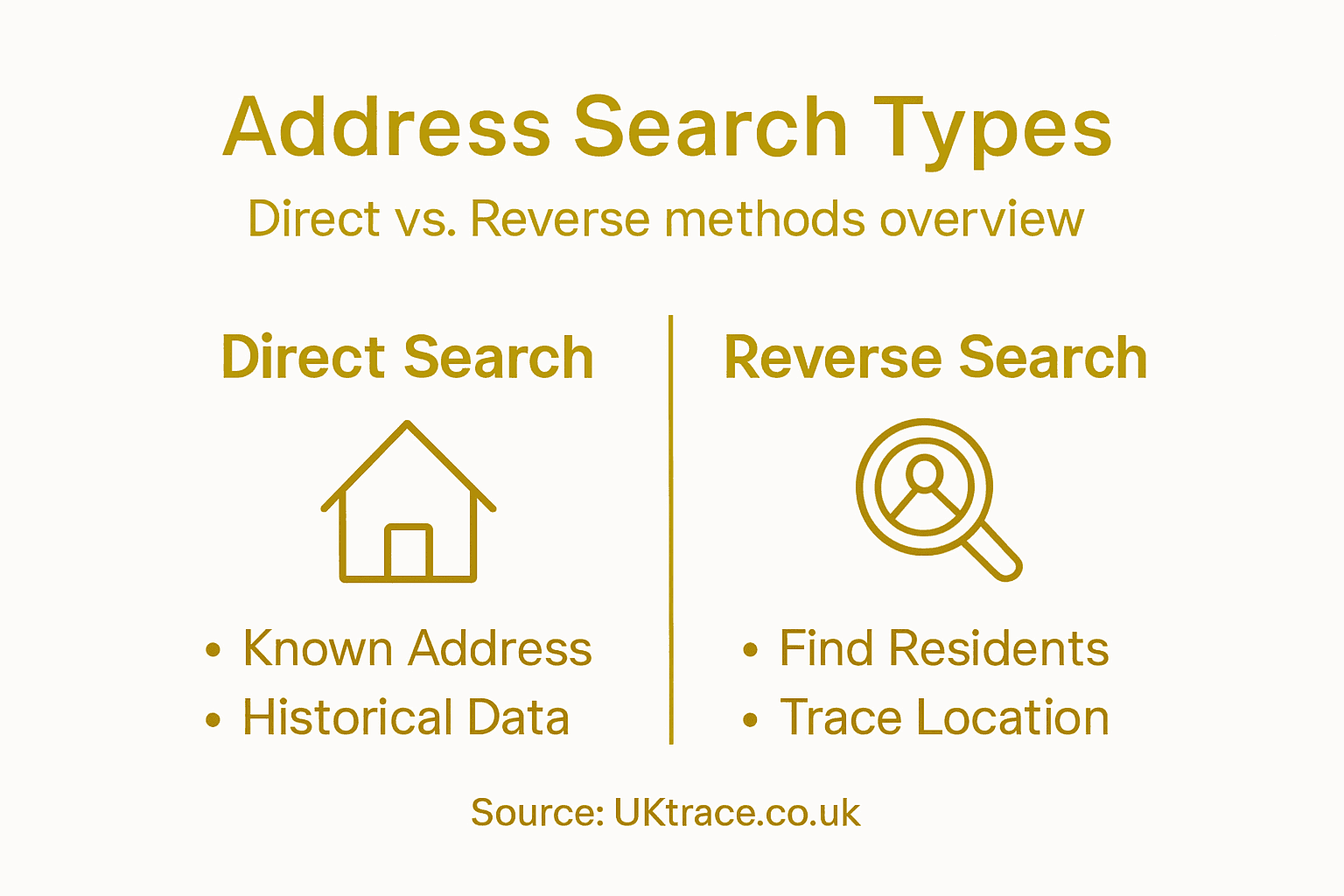
Address searches represent a sophisticated investigative technique with multiple methodological approaches tailored to specific research needs. Address search methods typically fall into two primary categories: direct and reverse searches, each serving distinct purposes in family investigations and personal research.

In direct address searches, researchers begin with a known address and seek comprehensive information about the location and its historical occupants. This approach involves retrieving property details, ownership records, and residential history associated with a specific geographic location. Conversely, reverse address searches operate differently - they start with an address as the primary input and aim to identify current or past residents, enabling genealogical researchers and investigators to trace family connections or validate residential histories.
The complexity of address searches extends beyond basic categorization, incorporating advanced research techniques that integrate demographic data, property records, and historical archives. These sophisticated searches can uncover nuanced information such as property ownership transitions, historical resident lists, and contextual geographic details that provide deeper insights into familial and community connections. Researchers must carefully select search methodologies based on specific investigation goals, available resources, and the depth of information required.
Pro tip: Combine multiple address search techniques and cross-reference results from different databases to ensure the most comprehensive and accurate information possible.
Here’s a comparison of direct versus reverse address search methods:
| Criteria | Direct Address Search | Reverse Address Search |
|---|---|---|
| Starting Input | Known address | Geographic location or address |
| Main Objective | Retrieve location and occupants info | Identify residents or family links |
| Typical Data Sources | Property records, ownership archives | Utility records, municipal archives |
| Use Cases | Building property histories | Tracing genealogy connections |
How Reverse Address Lookups Work Online
Reverse address lookups represent a sophisticated digital investigative technique that transforms geographical or address-based data into comprehensive personal and residential information. Reverse lookup technologies utilize complex algorithmic processes to translate raw address inputs into detailed, actionable insights, enabling researchers to uncover critical information about specific locations and their historical occupants.
The technical mechanism behind online reverse address searches involves multiple interconnected systems. Geocoding engines process geographic coordinates and postal identifiers through extensive databases, matching input data against verified residential records. These sophisticated systems draw from multiple sources including municipal records, utility registrations, property tax documents, and historical residential archives to generate comprehensive profile information about a specific address or location.
Geocoding algorithms power the most advanced reverse address lookup platforms, enabling precise data retrieval by converting geographic coordinates into standardized address formats. These digital investigation tools can trace residential histories, validate property ownership details, and provide contextual information about specific locations. The process involves complex data matching techniques that cross-reference multiple databases to ensure accuracy and comprehensiveness of retrieved information.
Pro tip: Always verify reverse address lookup results by cross-referencing at least two independent data sources to ensure maximum information reliability and accuracy.
Legal and Privacy Standards in the UK
Address searches in the United Kingdom operate within a stringent legal framework designed to protect individual privacy while enabling legitimate investigative processes. Data protection regulations establish comprehensive guidelines that govern how personal information can be collected, processed, and utilized during family investigations, ensuring a delicate balance between research needs and individual rights.
The Data Protection Act 2018 serves as the cornerstone of privacy legislation, complementing European Union General Data Protection Regulation (GDPR) standards. This legislation mandates that any address search must adhere to strict principles of lawfulness, fairness, and transparency. Investigators must obtain explicit consent, minimize data collection, and ensure that personal information is processed only for specific, legitimate purposes directly related to the investigation’s objectives.
Legal search parameters outlined in the Police and Criminal Evidence Act 1984 (PACE) provide additional protections by establishing clear boundaries for information retrieval. These standards require that address searches be proportionate, necessary, and conducted with utmost respect for individual privacy. Researchers and investigators must maintain detailed records of their search processes, ensuring that each step can be justified and that no unnecessary personal information is collected or retained beyond the investigation’s immediate requirements.
Pro tip: Always obtain written consent and maintain a detailed log of your address search activities to ensure full compliance with UK data protection regulations.
Below is a summary of key legal requirements for conducting address searches in the UK:
| Legal Principle | Description | Impact on Investigations |
|---|---|---|
| Consent Requirement | Written consent must be obtained | Protects individual privacy |
| Data Minimization | Only necessary data should be collected | Limits unnecessary information |
| Record Keeping | Search activities must be documented | Ensures process transparency |
| Lawful Purpose | Information used for legitimate reasons | Prevents misuse of personal data |
Practical Uses for Family and Ancestry Research
Address searches play a transformative role in family and ancestry research, offering researchers powerful tools to uncover complex familial histories and connections. Family history investigations leverage address searches to reconstruct detailed genealogical narratives by accessing comprehensive historical records that reveal migration patterns, residential transitions, and generational movements.
Historical research techniques utilize address searches to track family lineages across multiple generations. These investigations can identify critical information such as property ownership records, census data, birth and death registrations, and electoral roll entries. By systematically cross-referencing address-related documents, researchers can trace ancestral migrations, understand socioeconomic changes, and piece together intricate family narratives that might otherwise remain hidden.
Genealogical research strategies demonstrate how address searches enable investigators to validate familial connections, confirm relationships, and explore demographic shifts. These searches provide context beyond simple names and dates, offering insights into family structures, community dynamics, and individual life trajectories. Researchers can map family movements, understand historical residential patterns, and reconstruct personal histories with unprecedented detail and accuracy.
Pro tip: Always maintain a systematic documentation process during your address search investigations, creating detailed logs that track each discovered connection and potential research pathway.
Common Pitfalls and Accuracy Concerns
Address searches in family investigations are vulnerable to complex data challenges that can significantly compromise research accuracy and reliability. Research methodologies reveal multiple potential pitfalls, including database inconsistencies, partial data matches, and inherent biases that can lead researchers astray if not carefully navigated.
Data matching complexities represent a critical challenge in address-based research. Investigators frequently encounter issues such as transcription errors, outdated records, name variations, and incomplete historical documentation. These discrepancies can create false connections or obscure legitimate familial relationships, requiring meticulous cross-referencing and verification of multiple independent sources to ensure investigative integrity.
Investigative accuracy protocols emphasize the importance of implementing rigorous verification processes. Researchers must develop systematic approaches to validate information, including consulting multiple databases, comparing cross-referenced records, and maintaining a skeptical approach to initial findings. Potential biases in historical records, particularly those related to marginalized communities, demand heightened scrutiny and a nuanced understanding of historical documentation practices.
Pro tip: Always maintain a skeptical approach to initial research findings, cross-referencing at least three independent sources before drawing definitive conclusions about familial connections.
Unlock Powerful Family Insights with Expert Address Searches
Address searches play a pivotal role in overcoming challenges like data inconsistencies, verifying identities, and tracing residential histories explored in the article. Whether you are piecing together complex family ties or seeking to locate lost relatives, the key pain points include ensuring accuracy, navigating vast data sources, and complying with privacy standards. With concepts such as reverse address lookups and direct property history verification, it is essential to access reliable and comprehensive data quickly.
Discover how Name and address searches UK at UKtrace.co.uk can simplify your investigative journey.
Take control of your family investigation now by leveraging services designed for confidentiality and precision. Visit UKtrace.co.uk to access trusted electronic tracing solutions tailored for the UK. For a deeper dive into property details supporting your research, explore UK Land and property searches. Begin your search today and bring clarity to your family history with confidence.
Frequently Asked Questions
What are address searches and how do they work?
Address searches are investigative techniques that uncover detailed information about specific locations and their residents. They retrieve data about physical addresses using data sources like public records and ownership archives.
What is the difference between direct and reverse address searches?
Direct address searches start with a known address to gather information on the location and its historical occupants. In contrast, reverse address searches identify residents linked to a specific address, making them useful for tracing family connections.
How can address searches aid in family and ancestry research?
Address searches help researchers reconstruct familial histories by accessing historical records that reveal residential transitions, property ownership, and migration patterns, leading to deeper insights into family narratives.
What legal considerations should I keep in mind when conducting address searches?
When conducting address searches, it’s essential to adhere to data protection regulations, obtain consent, minimize data collection, and document all search activities to ensure compliance with privacy standards.