
Finding an accurate address in the United Kingdom can prove challenging, especially when privacy and correctness are essential for investigations or identity checks. The demand for dependable verification is driven by a need for confidentiality and precise information retrieval, whether for legal, personal, or business purposes. This guide sheds light on how specialized address tracing services use advanced tools and respected UK databases to deliver results while respecting strict privacy regulations.
Table of Contents
- What Address Tracing Means in the UK
- Key Methods for UK Address Tracing
- When to Use Address Tracing Services
- Legalities and Privacy in UK Address Tracing
- Common Pitfalls and Risk Mitigation
Key Takeaways
| Point | Details |
|---|---|
| Address Tracing | It is a complex process that employs multiple methodologies to locate residential and business addresses while ensuring compliance with data protection regulations. |
| Legal Compliance | Address tracers must navigate intricate legal frameworks, including the UK GDPR, to ensure that personal data is handled appropriately. |
| Use Cases | Various sectors benefit from address tracing, including legal investigations, humanitarian efforts, and asset recovery, emphasizing its broad applicability. |
| Risk Mitigation | Implementing rigorous verification protocols and maintaining clear documentation are essential strategies to prevent legal complications during address tracing. |
What Address Tracing Means in the UK
Address tracing in the United Kingdom represents a sophisticated process of systematically identifying and verifying residential and business location information. Unlike basic directory searches, this practice involves comprehensive investigative techniques designed to locate precise address details across complex urban and rural landscapes.
The process of address tracing incorporates multiple methodological approaches, including mapping address components that help identify specific geographical locations. These methods typically involve several key strategies:
- Cross-referencing multiple public and private databases
- Analyzing historical property records
- Utilizing geographic information system (GIS) technologies
- Verifying current and previous occupancy information
Understanding address tracing requires recognizing its critical role in various contexts. Individuals and organizations might seek address verification for multiple reasons, such as:
- Legal investigations
- Genealogical research
- Asset location and recovery
- Background verification processes
- Personal reconnection efforts
In the UK specifically, address tracing goes beyond simple location identification. It involves navigating complex data protection regulations while providing accurate, privacy-compliant information retrieval. Professional address tracing services understand the nuanced legal landscape, ensuring that all information gathering adheres to strict data protection standards.
Address tracing is not just about finding a location—it’s about connecting information responsibly and ethically.
Pro tip: Always verify the legitimacy and legal compliance of any address tracing service before initiating a search.
Key Methods for UK Address Tracing
Address tracing in the United Kingdom involves sophisticated techniques that leverage multiple data sources and advanced technological platforms. Professionals utilize comprehensive strategies to retrieve accurate location information while maintaining strict adherence to data protection regulations.
One primary method involves utilizing the comprehensive Royal Mail Postcode Address File, which serves as a foundational resource for verifying residential and business addresses. This extensive database contains critical details about delivery points across the United Kingdom, enabling precise location identification.
Key address tracing methodologies include:
- Accessing official government databases
- Analyzing historical property records
- Utilizing geographical mapping services
- Cross-referencing multiple public and private information sources
- Employing advanced geographic information system (GIS) technologies
The process of address tracing requires a multifaceted approach that combines technological tools with investigative expertise. Professionals must navigate complex data protection regulations while ensuring the accuracy and reliability of retrieved information. This involves:
- Verifying source authenticity
- Maintaining strict confidentiality standards
- Implementing robust data validation protocols
- Utilizing secure technological platforms
- Adhering to legal compliance requirements
Professional address tracing demands a nuanced understanding of information retrieval techniques and legal frameworks. Investigators must balance technological capabilities with ethical considerations, ensuring that all searches respect individual privacy rights and comply with UK data protection standards.
Effective address tracing is about precision, integrity, and responsible information management.
Pro tip: Always confirm the legal authorization and purpose of your address trace before initiating any search.
When to Use Address Tracing Services
Address tracing services play a crucial role in numerous personal, professional, and humanitarian contexts across the United Kingdom. These specialized services provide critical support for individuals and organizations seeking to locate, verify, or reconnect with specific addresses and their associated contacts.
In humanitarian settings, tracing services help reunite families separated by migration, conflict, or emergency situations. These services become lifelines for individuals seeking to reestablish lost connections or verify the whereabouts of loved ones during challenging circumstances.
Key scenarios where address tracing services prove essential include:
- Legal investigations requiring precise location verification
- Genealogical and ancestry research
- Debt recovery and asset location
- Inheritance and estate management
- Insurance claim investigations
- Tenant and property background checks
- Locating potential witnesses for legal proceedings
Beyond personal uses, address tracing services are critical in professional domains such as:
- Logistics and delivery optimization
- Healthcare resource allocation
- Government demographic planning
- Emergency response coordination
- E-commerce customer verification
Professional address tracing involves sophisticated techniques that balance technological capabilities with strict ethical and legal standards. Comprehensive address databases enable precise location identification while maintaining individual privacy protections.
Here’s a comparison of address tracing use cases in the UK:
| Use Case | Who Benefits | Typical Outcome |
|---|---|---|
| Legal investigations | Law firms, police | Verified addresses for court needs |
| Humanitarian tracing | Charities, families | Reunited relatives, location info |
| Logistics optimization | Delivery companies | Improved route and delivery speed |
| Asset recovery | Financial institutions | Located properties, reduced losses |
Address tracing is more than finding a location—it’s about connecting people responsibly and ethically.
Pro tip: Always verify the legal authorization and specific purpose of your address trace to ensure compliance with data protection regulations.
Legalities and Privacy in UK Address Tracing
Address tracing in the United Kingdom operates within a complex legal framework designed to protect individual privacy while enabling legitimate information retrieval. The intricate balance between accessing necessary information and safeguarding personal data requires a nuanced understanding of regulatory requirements.

UK data protection regulations establish stringent guidelines for handling personal address information. These legal mechanisms ensure that any address tracing activity maintains strict confidentiality and respects individual privacy rights.
Key legal considerations for address tracing include:
- Compliance with UK General Data Protection Regulation (UK GDPR)
- Obtaining explicit consent for data processing
- Implementing robust data security measures
- Limiting access to authorized personnel
- Ensuring transparency in information usage
- Protecting individual identification details
- Maintaining accurate and current information
The legal framework governing address tracing involves multiple critical principles:
- Purpose limitation
- Data minimization
- Individual consent requirements
- Secure information storage
- Restricted information access
Under UK GDPR guidelines, organizations must demonstrate:
- Clear justification for address information retrieval
- Specific and legitimate purposes for data processing
- Transparent communication about data usage
- Mechanisms for individual data access and correction
- Comprehensive documentation of information handling processes
Professional address tracing requires meticulous attention to legal and ethical standards. Practitioners must navigate complex regulations while maintaining the highest levels of integrity and respect for personal privacy.
Responsible address tracing balances informational needs with fundamental privacy protections.
Pro tip: Always document your specific purpose and legal basis for address tracing to ensure full compliance with data protection regulations.
Common Pitfalls and Risk Mitigation
Address tracing involves numerous potential risks that require careful navigation and strategic management. Understanding these potential vulnerabilities is crucial for maintaining legal compliance and protecting sensitive information throughout the investigation process.
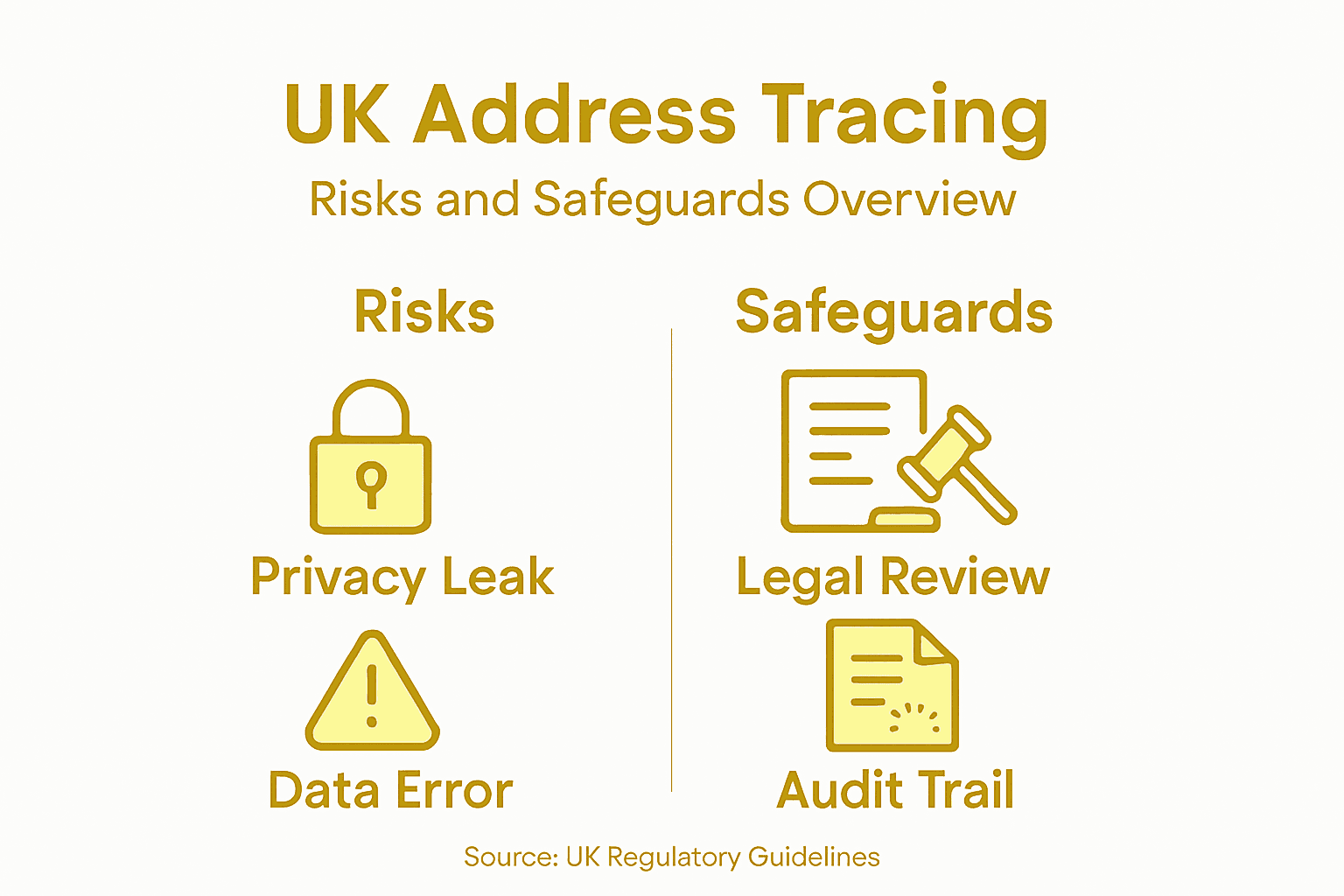
Address misrepresentation risks can lead to significant legal complications if not properly managed. Unauthorized data usage, undisclosed occupancy, or inappropriate information sharing may result in civil or criminal consequences.
Common pitfalls in address tracing include:
- Insufficient data verification processes
- Inadequate consent documentation
- Improper information storage
- Lack of secure transmission protocols
- Incomplete background checks
- Overlooking data protection regulations
- Failing to update outdated information
Key risk mitigation strategies involve:
- Implementing rigorous verification protocols
- Maintaining comprehensive documentation
- Conducting regular compliance audits
- Training personnel on legal requirements
- Establishing clear data handling procedures
Professional risk management requires a multifaceted approach. Systematic risk assessment techniques help organizations identify, evaluate, and minimize potential vulnerabilities in address tracing processes.
Understanding and anticipating potential risks allows investigators to develop robust safeguards that protect both the information seeker and the individuals whose addresses are being traced.
A summary of risk mitigation essentials for address tracing:
| Mitigation Action | Why It Matters | Best Practice Example |
|---|---|---|
| Verification protocols | Prevents false information | Double-check databases |
| Audit trails | Ensures legal compliance | Record all trace activities |
| Secure data storage | Protects sensitive details | Use encrypted platforms |
| Staff training | Reduces costly errors | Regular legal workshops |
Effective risk mitigation is about prevention, not just reaction.
Pro tip: Always maintain a detailed audit trail of your address tracing activities to demonstrate compliance and protect against potential legal challenges.
Secure Your Peace of Mind with Expert Address Tracing Services
Address tracing in the UK involves navigating complex challenges like verifying identities, ensuring legal compliance, and safeguarding privacy. The emotional weight of locating lost relatives or confirming trustworthy contacts demands precision and confidentiality. At UKtrace.co.uk, we understand these critical pain points and provide tailored solutions such as Name and address searches UK to help you overcome them with confidence.
Don’t let uncertainty or incomplete information compromise your trust or investigations. Act now to access accurate, legally compliant, and confidential tracing services. Visit UKtrace.co.uk today to start your search. Explore additional resources like our Birth, Marriage and Death searches to deepen your research and safeguard identity with expert help.
Frequently Asked Questions
What is address tracing?
Address tracing is a process used to identify and verify residential and business location information through various investigative techniques and data sources.
Why is address tracing important for safeguarding identity?
Address tracing is crucial for safeguarding identity as it helps verify personal information, ensuring that individuals and organizations connect with the correct parties and reduce the risk of fraud.
How do privacy regulations affect address tracing?
Privacy regulations, such as the UK General Data Protection Regulation (GDPR), enforce strict guidelines on how personal data, including addresses, can be collected, processed, and stored, ensuring individual privacy rights are protected.
When should I consider using an address tracing service?
You should consider using an address tracing service for various situations, including legal investigations, genealogical research, background checks, and humanitarian efforts to reconnect families.