
Tracing family roots or confirming someone’s identity in the United Kingdom comes with its own set of challenges. When one simple mistake leads to the wrong address, weeks of research or personal conversations can be lost. Complete and accurate address information is recognised by the Office for National Statistics as the backbone for reliable results in official statistics and personal investigations. This guide will help you understand address search accuracy, why it matters for genealogy and investigations, and how you can avoid common errors.
Table of Contents
- Defining Address Search Accuracy And Its Role
- Main Types And Methods Used In The UK
- Achieving Reliable Results: Key Processes Explained
- Legal Compliance And Privacy Obligations In Address Searches
- Common Pitfalls, Risks And How To Avoid Errors
Key Takeaways
| Point | Details |
|---|---|
| Importance of Accuracy | Accurate address searches are vital for successful personal investigations, as errors can lead to wasted time and damage relationships. |
| Multifaceted Search Methods | Employing various sources, including electoral registers and land registries, enhances the accuracy and reliability of address information. |
| Legal Compliance | Adhere to data protection laws during address research to ensure privacy and maintain ethical standards in your inquiries. |
| Avoid Common Pitfalls | Use multiple authoritative sources to avoid errors caused by outdated information, formatting issues, or confusing similar addresses. |
Defining Address Search Accuracy And Its Role
Address search accuracy means finding the right person at the right location with reliable, current information. It’s not simply about getting any result—it’s about getting the correct one that matches your search purpose.
When you’re tracing a relative or verifying someone’s identity, inaccurate addresses create real problems. You might contact the wrong household, waste weeks on dead ends, or worse, damage relationships by approaching strangers with personal questions meant for someone else.
What Makes an Address Search Accurate?
Accurate address searches rely on several key factors:
- Current data: Information updated regularly to reflect moves, name changes, and property transfers
- Reliable sources: Cross-referenced records from multiple verified databases and official registries
- Proper matching: Sophisticated systems that connect names, dates, and addresses without mixing records
- Geographical precision: Exact location data that distinguishes between similar addresses or flat numbers
Complete and accurate address information is critical for reliable geographical referencing, as recognised by official statistics services. This foundation ensures you’re working with trustworthy data from the start.
Accuracy isn’t a luxury feature—it’s the foundation of successful personal investigations and family history research.
Why Accuracy Matters for Your Search
Familiar with genealogy research, you know how one incorrect detail creates cascading errors. What address tracing achieves depends entirely on the quality of information you retrieve. A wrong postal code might eliminate genuine leads; an outdated address sends you searching for someone who moved years ago.
Accuracy directly affects:
- Time spent on fruitless searches versus productive leads
- Your ability to contact the right person on the first attempt
- Confidence in genealogical records and family connections
- Prevention of embarrassing or harmful contact with wrong individuals
When you’re rebuilding family connections or verifying identities online, precision prevents costly mistakes.
Pro tip: Before relying on any address information, cross-check it against multiple sources like electoral registers, property records, or census data to confirm accuracy before making contact.
Main Types And Methods Used In The UK
The UK employs several distinct approaches to address searching, each suited to different research goals. Understanding these methods helps you choose the right tool for locating people and verifying identities.
Address searching in the UK isn’t a single process—it’s a combination of technologies, databases, and official records working together. Different methods complement each other, giving you multiple angles to find accurate information.

Database-Driven Address Matching
Modern address searches rely on data science methods for matching that parse multiple data sources simultaneously. The system retrieves candidates, scores matches, and ranks results based on reliability.
This approach integrates:
- AddressBase records: The comprehensive UK address register maintained by Ordnance Survey
- Administrative data: Information from government agencies and official registries
- Survey inputs: Historical data from census operations and social surveys
- Real-time updates: Current matching that reflects recent moves and changes
When you search for someone, these systems work in milliseconds to cross-reference your query against multiple sources simultaneously.
Modern address matching isn’t guesswork—it’s sophisticated technology processing multiple authoritative sources at once.
Official Searches Through Land Registry
For property-related investigations, official searches registered through HM Land Registry retrieve precise ownership and legal information. These searches access title registers and indices to confirm who owns what and when changes occurred.
Official searches cover:
- Title register information: Property ownership, boundaries, and registered interests
- Legal status confirmation: Whether properties have restrictions or pending charges
- Historical records: Previous ownership chains and changes over time
- Precise identification: Exact floor levels, flat numbers, and title references
These methods guarantee accuracy because they’re drawn from official, legally binding registers.
Electoral Registers and Council Records
Local council records and electoral registers provide another essential layer. Residents appearing on electoral registers confirm current or recent addresses, and these records update annually.
They’re particularly useful for:
- Confirming someone still lives at a known address
- Identifying household members or family connections
- Tracing movements over consecutive years
Reverse Address Searches
When you know an address but need to find who lives there, address search methods for reliable results match current occupants against historical records. This works backward from location to person.
Pro tip: Use multiple methods together—cross-reference database results against official Land Registry searches and electoral records to confirm accuracy before contacting anyone.
Here is a comparison of major address search methods in the UK and their distinct advantages:
| Method | Data Source Type | Typical Use Case | Distinct Advantage |
|---|---|---|---|
| Database-Driven Matching | Integrated digital | Fast person or address lookup | Handles large-scale queries |
| Land Registry Search | Official government | Property and owner research | Legal certainty, historical data |
| Electoral Register Search | Local council records | Confirm recent residency | Identifies occupants and changes |
| Reverse Address Search | Mixed/historical | Find who lives at address | Cross-verifies with old records |
Achieving Reliable Results: Key Processes Explained
Behind every accurate address search is a structured process that breaks down your query, searches databases intelligently, and ranks results by reliability. Understanding how this works helps you trust the information you receive.
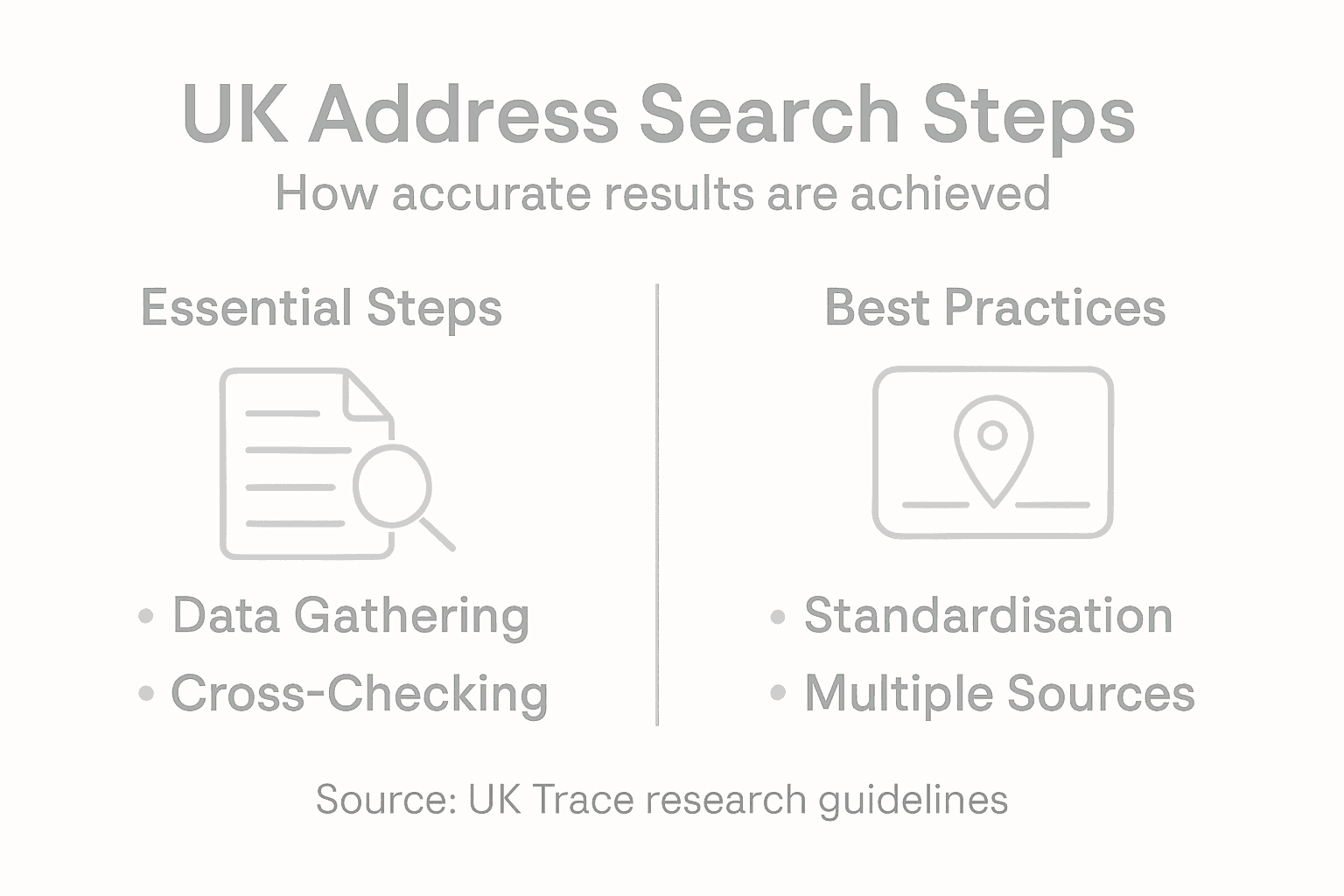
When you submit a search, the system doesn’t simply look for exact matches. Instead, it uses sophisticated logic to find what you’re looking for, even when details are incomplete or slightly different from how they’re recorded.
The Four-Step Matching Process
Address matching processes include parsing, retrieval, scoring and ranking to deliver accurate results. This structured approach ensures consistency and reliability across millions of searches.
The process works like this:
-
Parsing: Your search input gets broken down into components—street number, road name, town, postcode. This separation allows the system to match parts independently.
-
Candidate retrieval: The system searches standardised address databases for potential matches using those components.
-
Scoring: Each candidate gets assessed for similarity to your original query, considering spelling variations, abbreviations, and common data entry errors.
-
Ranking: Results appear ordered by confidence level, with the most likely match first.
This layered approach handles real-world messiness—incomplete addresses, abbreviations, spelling differences—that would trip up simple keyword matching.
The strongest results aren’t lucky guesses; they’re generated by algorithms specifically designed to handle imperfect data.
Why Each Step Matters for Your Search
Skipping any step would reduce accuracy. Parsing prevents the system from confusing street numbers with house names. Candidate retrieval limits the search space to realistic matches. Scoring separates genuine matches from false positives. Ranking puts reliable results first.
For genealogy research, this matters enormously. A relative’s address might be recorded slightly differently in various records. The matching process catches these variations:
- “St” versus “Saint”
- “Road” versus “Rd”
- Old place names versus current ones
- Spelling variations in surnames
Performance Evaluation and Scalability
Reliable systems test themselves constantly. Performance evaluation ensures the process maintains high accuracy across millions of searches without slowing down response times. This is essential for operational use—you need answers quickly without sacrificing precision.
The system scales to handle demand whilst preserving accuracy. Whether searching for one person or validating thousands of addresses, the reliability remains consistent.
Pro tip: Pay attention to confidence levels in your results—top-ranked matches have been scored highest by the system’s algorithms, making them most reliable for contacting or further investigation.
Legal Compliance And Privacy Obligations In Address Searches
When searching for addresses and people in the UK, you’re handling personal data. This comes with legal responsibilities under data protection law. Understanding these obligations protects you legally and respects the privacy of those you’re investigating.
Address searches aren’t completely unrestricted. The law sets clear boundaries on how personal data can be collected, used, and stored. These rules apply whether you’re researching family history or verifying identities.
UK Data Protection Requirements
UK GDPR and Data Protection Act 2018 govern how personal data including addresses must be handled. Organisations must process data lawfully, transparently, and securely. This means address data must be accurate, limited to what’s genuinely needed, and kept only as long as necessary.
Compliance requires:
- Lawful purpose: You need a valid reason to search for someone’s address (genealogy research or identity verification qualify)
- Transparency: If you contact someone, you must be honest about who you are and why you’re searching
- Data security: Information must be protected from unauthorised access
- Minimal retention: Don’t store addresses longer than your research needs
These aren’t bureaucratic hurdles—they’re designed to protect people’s privacy whilst allowing legitimate investigation.
Data protection law doesn’t stop address searching; it ensures you do it responsibly and legally.
Individual Rights During Address Searches
People have rights over their own personal data. They can request access to information held about them and ask for corrections if details are wrong. When tracing family members, if someone discovers you’ve searched for them, they have recourse under data protection law.
This matters for your investigation because:
- Accuracy checks: If you locate someone, their right to correct errors means the information you find should be current and correct
- Transparency obligations: If you contact them, you must explain how you obtained their address
- Legitimate interest: Your genealogy research or identity verification counts as a legitimate reason under the law
Ethical Considerations Beyond Legal Requirements
Just because something is legally permissible doesn’t mean it’s wise. When investigating family histories through address searches, consider the emotional impact of unexpected contact.
Before contacting someone you’ve traced, think carefully about:
- Whether they want to be found
- How to approach them sensitively
- What information you’re comfortable sharing about your search methods
- Whether intermediaries might help break the ice
Survivors of family separation or estrangement may have complex feelings about being traced. Respectful contact matters as much as legal compliance.
Pro tip: Keep records of your search methods and purposes—if anyone questions why you searched for their address, you’ll need to demonstrate you had a legitimate, lawful reason and followed data protection principles.
Common Pitfalls, Risks And How To Avoid Errors
Even experienced researchers make mistakes when searching for addresses. These errors waste time, damage relationships, and can lead you down wrong paths. Knowing what goes wrong helps you avoid costly mistakes.
Most address search failures aren’t mysteries. They result from predictable errors that are entirely preventable with the right approach.
The Single Source Problem
Relying on one data source is the biggest pitfall in address research. That single source might be outdated, incomplete, or contain errors. One household’s information doesn’t guarantee accuracy across different records.
Common pitfalls in address verification involve relying solely on single data sources and neglecting proper verification methods. Using multiple authoritative sources dramatically improves reliability.
When searching for someone:
- Cross-reference electoral registers with council records
- Check Land Registry information against property databases
- Verify postcode data against Royal Mail records
- Compare results from multiple genealogy sources
This multi-source approach catches discrepancies before you act on faulty information.
A single source is a starting point, not a destination. Verification requires triangulation across multiple databases.
Formatting And Standardisation Issues
Addresses recorded in different systems use different formats. A street name might appear as “St” in one database and “Saint” in another. Postcode variations, flat numbering differences, and abbreviations create confusion.
Formatting problems cause:
- Failed matches: The system can’t find results because your search doesn’t match recorded formats
- Missed connections: You overlook results because they don’t look exactly like your search terms
- Wasted searches: You search repeatedly with slight variations without realising you’re looking at the same address
Standardising addresses before searching—using proper postal formatting and consistent abbreviations—solves most formatting problems.
Outdated Information And Regular Updates
People move. Families relocate. Postcodes change. An address correct five years ago might be completely wrong today. Outdated address records lead to failed searches and wasted costs, making regular updates essential.
For genealogy research, this matters differently. Historical accuracy is your goal, so older records are valuable. But when locating living relatives, you need current information.
Track these change indicators:
- Electoral register updates (annual)
- Council records (moving homes)
- Royal Mail redirects (when available)
- Census records (historical context)
Confusing Similar Addresses
You find an address matching your search, but it’s not the right one. Similar street names, duplicate flat numbers in different buildings, or common surnames create false positives.
This happens when you:
- Don’t cross-check names against addresses
- Ignore dates of birth or middle names
- Assume the first match is correct
- Skip verification with other sources
Always verify matched addresses by checking multiple identifying details—not just the location.
This table highlights common address search errors and strategies for prevention:
| Common Pitfall | Typical Consequence | Best Practice to Avoid |
|---|---|---|
| Reliance on one source | Outdated or wrong results | Use multiple authoritative sources |
| Formatting mismatches | Missed or failed matches | Standardise search formats |
| Out-of-date records | Wasted time and resources | Prioritise current databases |
| Similar addresses | Contacting wrong household | Verify using unique identifiers |
Pro tip: Before contacting anyone at an address you’ve found, verify using at least three independent sources and check that names, dates, and property details all align correctly.
Discover Unrivalled Accuracy in Address Searches with UK Trace
Finding the right address is never just about luck. If you want to avoid the common pitfalls of outdated or inconsistent information discussed in this article, UKtrace.co.uk offers specialised solutions that prioritise accuracy, confidentiality, and reliability. Whether you are conducting personal investigations or professional identity verifications, our advanced electronic tracing services combine multiple verified sources to deliver precise matches every time.
Take control of your research by exploring our Name and address searches UK category where you can access reverse address searches, identity verifications, and contact detail discoveries that save you precious time and prevent costly errors. For property-related inquiries, our UK Land and property searches provide legal certainty through official records. Start your accurate address search journey today by visiting UKtrace.co.uk and equip yourself with the tools to get results you can trust.
Frequently Asked Questions
What is address search accuracy?
Address search accuracy refers to the ability to identify the correct person at the right location using reliable and current information, minimising the risk of contacting the wrong individual.
Why is accuracy important in address searches?
Accuracy is crucial because it affects the effectiveness of your search. Incorrect addresses can lead to wasted time, miscommunication, and potentially harmful interactions with the wrong individuals.
What factors contribute to accurate address searches?
Accurate address searches rely on current data, reliable sources, proper matching of information, and geographical precision to ensure you get trustworthy results.
How can I improve the accuracy of my address searches?
To enhance the accuracy of your searches, cross-check information against multiple sources like electoral registers, property records, and census data before making contact.
Recommended
- What Is Address Tracing and Why Accuracy Matters – UK Trace
- Defining UK Address Search: Accuracy and Legal Impact – UK Trace
- Address Search Methods: Reliable Results for UK Needs – UK Trace
- Role of Address Searches – Impact on Family Investigations – UK Trace
- 7 Essential Tools for Website Performance Monitoring List - 40Q
- Change of Address Services - USPS & Government | GovComplete