
Tracking down a lost relative, unraveling family history, or confirming details for a legal matter in the United Kingdom often hinges on finding the right address information. The accuracy of an address search is more than a convenience—it safeguards privacy and ensures sensitive investigations are based on facts you can trust. With every property in Great Britain carrying a Unique Property Reference Number, you gain reliable data cross-referencing that supports confidentiality and accurate data retrieval every step of the way.
Table of Contents
- What Is UK Address Search And Why It Matters
- Main Types Of UK Address Searches Explained
- How Electronic Address Tracing Works
- Legal Framework: Data Privacy And Consent
- Potential Risks And Common Pitfalls
Key Takeaways
| Point | Details |
|---|---|
| Importance of UK Address Search | UK address searches are essential for various functions, including genealogical research, legal verification, and business intelligence. |
| Types of Searches | Different types of UK address searches serve unique purposes, such as residential lookups for legal matters and commercial searches for business analysis. |
| Legal Considerations | Compliance with data protection laws is critical, requiring consent and transparency in data handling to protect personal address information. |
| Risks and Mitigation | Address data retrieval poses risks, including inaccuracy and privacy violations; organizations must implement validation strategies to ensure data integrity. |
What Is UK Address Search and Why It Matters
A UK address search represents a systematic process of retrieving comprehensive details about a specific property or location within the United Kingdom. This specialized investigative technique enables individuals and organizations to uncover precise residential and commercial address information with remarkable accuracy. The national address matching service provides critical geographical references essential for various administrative and personal purposes.
Addressing is more than just locating a physical space. UK address searches serve multiple crucial functions across different sectors:
- Genealogical research and family tracing
- Legal property verification
- Government administrative processes
- Census and statistical planning
- Business intelligence and marketing
Every addressable location in Great Britain has a Unique Property Reference Number (UPRN), which acts as a standardized identifier for precise data cross-referencing. This systematic approach ensures consistency and reduces potential errors in address-related communications.
Accurate address data is fundamental to effective resource allocation, policy monitoring, and administrative decision-making.
The significance of address searches extends beyond simple location tracking. These searches provide critical context, enabling professionals to validate residential histories, confirm property ownership, and support investigative processes with reliable geographical information.
Pro tip: Always verify the source and credibility of your address search service to ensure maximum accuracy and legal compliance.
Main Types of UK Address Searches Explained
UK address searches encompass several specialized techniques designed to retrieve precise location and property information. The National Address Gazetteer serves as a comprehensive repository that supports various address search methodologies across different professional and personal contexts.
The primary types of UK address searches include:
- Residential Address Lookup: Identifying current and historical occupants of a specific property
- Property Verification Search: Confirming legal ownership and property details
- Geographic Information System (GIS) Search: Mapping and spatial analysis of address locations
- Genealogical Research Search: Tracing historical address records for family history investigations
- Commercial Property Search: Investigating business address details and corporate location information
Each search type serves unique purposes and requires different levels of data access and investigative depth. Residential address searches are particularly crucial for legal proceedings, tenant verification, and personal investigations, while property verification searches provide critical information for real estate transactions and legal documentation.
Here is a comparison of the main types of UK address searches and their typical users:
| Search Type | Typical User | Key Benefit |
|---|---|---|
| Residential Address Lookup | Private investigators | Track current residents |
| Property Verification | Real estate agencies | Confirm property ownership |
| GIS Address Analysis | Urban planners | Visualize spatial patterns |
| Genealogy Address Tracing | Family historians | Discover historical ties |
| Commercial Property Lookup | Business analysts | Assess corporate locations |
Address searches are more than simple location tracking - they represent complex data retrieval processes that support multiple administrative and personal objectives.
Professional address searches typically involve cross-referencing multiple authoritative databases, including local council records, Royal Mail databases, and national address registries. This multi-source approach ensures high levels of accuracy and comprehensive information retrieval.
Pro tip: Always request multiple data points and cross-verify information from different sources to ensure maximum search accuracy.
How Electronic Address Tracing Works
Electronic address tracing represents a sophisticated digital process that leverages advanced data science techniques to retrieve and validate location information. Data science algorithms enable rapid and precise matching of address records through complex computational methods.
The electronic address tracing process typically involves several critical stages:
- Data Collection: Gathering information from multiple authoritative sources
- Address Parsing: Breaking down address components into standardized elements
- Candidate Retrieval: Identifying potential matching address records
- Scoring and Ranking: Evaluating address candidates for accuracy
- Verification: Cross-referencing multiple databases to confirm information
Matching algorithms play a crucial role in electronic address tracing by applying sophisticated scoring mechanisms. These algorithms analyze multiple data points, including street names, postal codes, historical residence information, and geographic coordinates to generate the most accurate results possible.
Electronic address tracing transforms complex data into actionable location intelligence, bridging the gap between raw information and meaningful insights.
Professional address tracing services utilize extensive databases that integrate information from local councils, Royal Mail, Ordnance Survey, and other official repositories. This multi-source approach ensures comprehensive coverage and significantly reduces the likelihood of errors in address identification.

Pro tip: Request a detailed report that shows the data sources used in your address trace to understand the depth and reliability of the information.
Legal Framework: Data Privacy and Consent
The legal landscape surrounding address data retrieval in the United Kingdom is complex and strictly regulated. Data protection principles govern how personal information can be collected, processed, and shared, ensuring individuals’ privacy rights remain protected.
Key legal considerations for address searches include:
- Consent Requirements: Explicit permission from data subjects
- Purpose Limitation: Clear justification for data retrieval
- Data Minimization: Collecting only necessary information
- Security Controls: Protecting personal data from unauthorized access
- Transparency: Informing individuals about data usage
Lawful processing of address information demands strict adherence to the Data Protection Act and General Data Protection Regulation (GDPR) standards. Organizations must demonstrate a legitimate legal basis for accessing and using personal address data, which typically falls under several specific categories such as legal obligation, vital interests, or explicit consent.
Personal address information represents sensitive data that requires rigorous protection and controlled access under UK legal frameworks.
Professional address search services must implement robust verification processes to ensure compliance with legal standards. This includes maintaining detailed audit trails, securing data transmission, and implementing strict access controls that prevent unauthorized information disclosure.
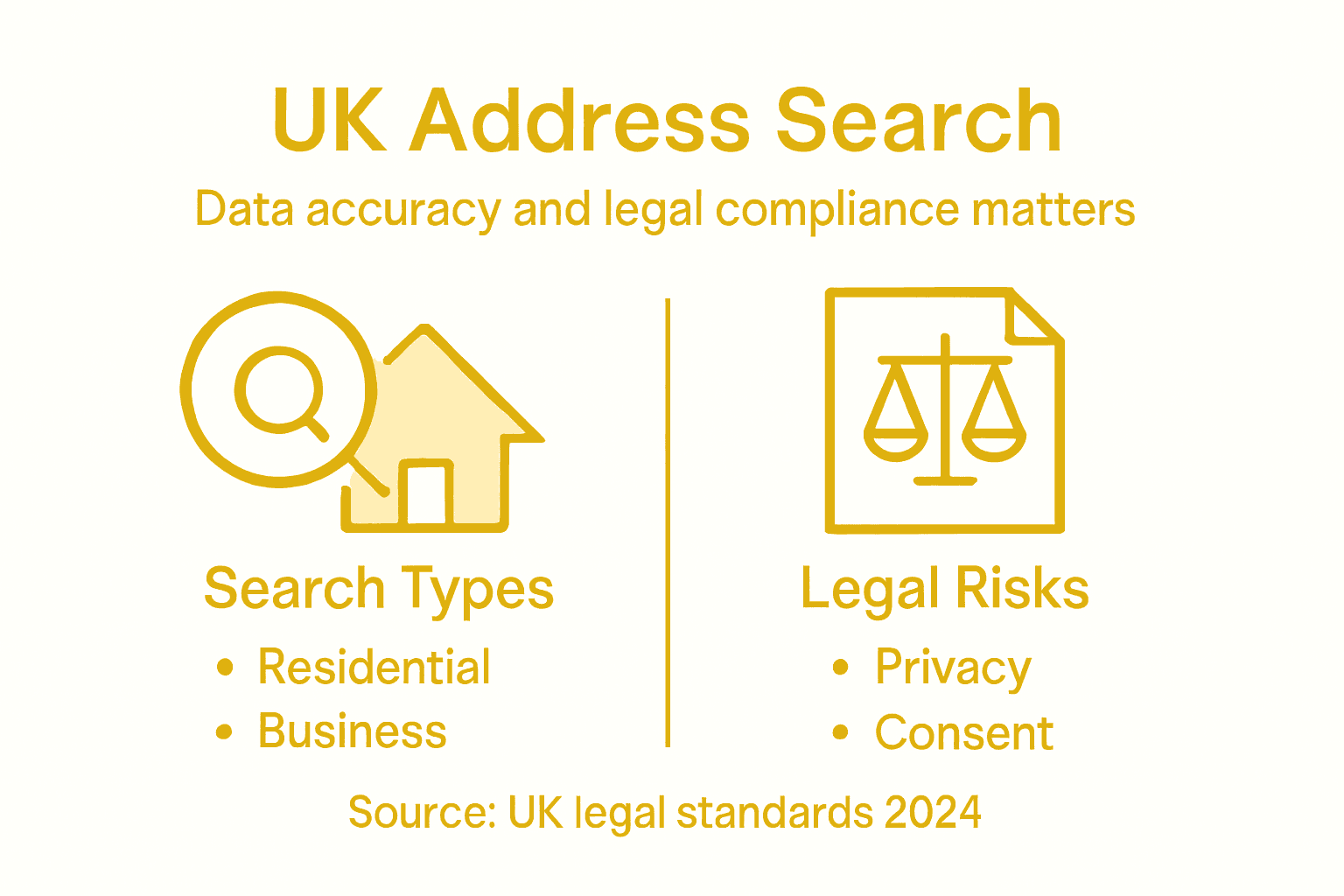
Pro tip: Always request documentation detailing the legal basis and consent mechanisms used in your address search to ensure full regulatory compliance.
Potential Risks and Common Pitfalls
Address data retrieval involves numerous complex challenges that can significantly impact search accuracy and reliability. Address data fragmentation creates substantial risks for individuals and organizations seeking precise location information.
Common risks in UK address searches include:
- Data Inaccuracy: Outdated or incorrect address records
- Incomplete Information: Partial or missing address details
- Duplicate Entries: Multiple conflicting address records
- Privacy Violations: Unauthorized data access
- Licensing Complications: Restrictive data usage permissions
Validation challenges emerge from complex data management processes. The privatization of address databases has created significant barriers, making comprehensive and accurate address searches increasingly difficult. Organizations must navigate intricate licensing requirements and continuously validate information sources to maintain data integrity.
This table summarizes common risks in address data retrieval and their business impact:
| Risk Factor | Potential Business Impact | Mitigation Strategy |
|---|---|---|
| Data Inaccuracy | Costly mistakes in transactions | Multi-source data validation |
| Incomplete Records | Missed legal or compliance deadlines | Request comprehensive records |
| Duplicate Entries | Confusion about property status | Employ record deduplication |
| Privacy Violations | Legal penalties, reputation damage | Enforce strict access controls |
| Licensing Issues | Restricted data usage capabilities | Secure clear data usage rights |
Address data reliability depends on rigorous verification and continuous monitoring of information sources.
Professional address search services must implement sophisticated cross-referencing techniques to mitigate risks. This involves leveraging multiple authoritative databases, conducting comprehensive validation checks, and maintaining robust data quality control mechanisms that minimize potential errors.
Pro tip: Request a comprehensive data provenance report to understand the sources and validation processes behind your address search results.
Unlock Precise UK Address Data With Confidence
Struggling with inaccurate or incomplete address information can lead to costly mistakes and legal complications. This article explained the critical need for thorough UK address searches using reliable data sources and compliance with data privacy laws. If you need to verify ownership, trace past occupants, or obtain detailed residential information, UKtrace.co.uk offers trusted solutions tailored for your needs.
Explore our expert Name and address searches UK services to access comprehensive and legally compliant address data. Whether you are investigating family history, confirming employee details, or conducting private inquiries, UKtrace.co.uk guarantees accuracy through multi-source validation while protecting your privacy. Start securing clear answers today by visiting https://uktrace.co.uk and take the first step toward trustworthy address intelligence.
Frequently Asked Questions
What is a UK address search?
A UK address search is a process used to retrieve detailed information about a specific property or location in the UK. It is essential for various purposes such as legal property verification, genealogical research, and administrative processes.
How does electronic address tracing work?
Electronic address tracing utilizes advanced data science techniques to collect and analyze multiple authoritative data sources, ensuring accurate and timely matches of address records.
Why is accuracy important in UK address searches?
Accuracy in UK address searches is crucial for effective resource allocation, legal compliance, and administrative decision-making. Inaccurate data can lead to costly mistakes and potential legal consequences.
What are the legal considerations for conducting an address search?
Legal considerations include obtaining explicit consent from data subjects, ensuring data minimization, and adhering to data protection laws such as the Data Protection Act and GDPR to protect individuals’ privacy rights.