
Searching for long-lost relatives or needing to confirm someone’s identity can be stressful without the right tools. In the UK, access to reliable address lookup processes transforms this challenge into a focused search using official records and authoritative data sources. By leveraging structured approaches that check everything from postcodes to historical census information, you reduce uncertainty and gain peace of mind. Learn how these electronic address lookup services bring clarity to family tracing and identity verification.
Table of Contents
- Defining Address Lookup Processes And Uses
- Types Of Address Searches And Key Differences
- Step-By-Step: How Address Lookup Works
- Legal Standards And Privacy Regulations In The UK
- Risks, Limitations, And Cost Considerations
Key Takeaways
| Point | Details |
|---|---|
| Address Lookup Importance | Address lookup is essential for verifying identities and reconnecting with lost relatives by cross-referencing multiple official data sources. |
| Search Methods Variations | Different search methods include keyword-based, identifier-based, and hierarchical searches, each suited for specific circumstances and data accuracy needs. |
| Verification Process | The lookup process involves systematic data matching and verification against unique identifiers to ensure accurate results. |
| Legal Protections | Services must comply with stringent UK privacy laws, ensuring data is managed ethically and users’ rights are protected. |
Defining Address Lookup Processes and Uses
Address lookup is the process of identifying and verifying specific location details using official records and data sources. Think of it as finding someone by their address rather than their name. You enter a postcode, street name, or property number, and the system returns verified information about that location and its residents. This straightforward approach has become essential for anyone trying to reconnect with lost relatives or verify someone’s identity in the UK.
These processes rely on official records and datasets including historical census information, property records, and modern government databases. When you search for an address, the system cross-references multiple sources to confirm the data is accurate and current. This verification step matters tremendously when you’re tracing family members or confirming where someone currently lives.
In practical terms, address lookup serves several key purposes for people like you:
- Locating relatives who moved away years ago
- Confirming someone’s current or past residential history
- Verifying identity details before conducting genealogical research
- Discovering contact information linked to specific addresses
- Checking property history and occupant details over time
The process works by matching your search criteria against vast databases containing postcodes, street records, and household information. Rather than manually checking old documents or making countless phone calls, address lookup does the heavy lifting electronically. This saves you weeks of frustrating detective work.
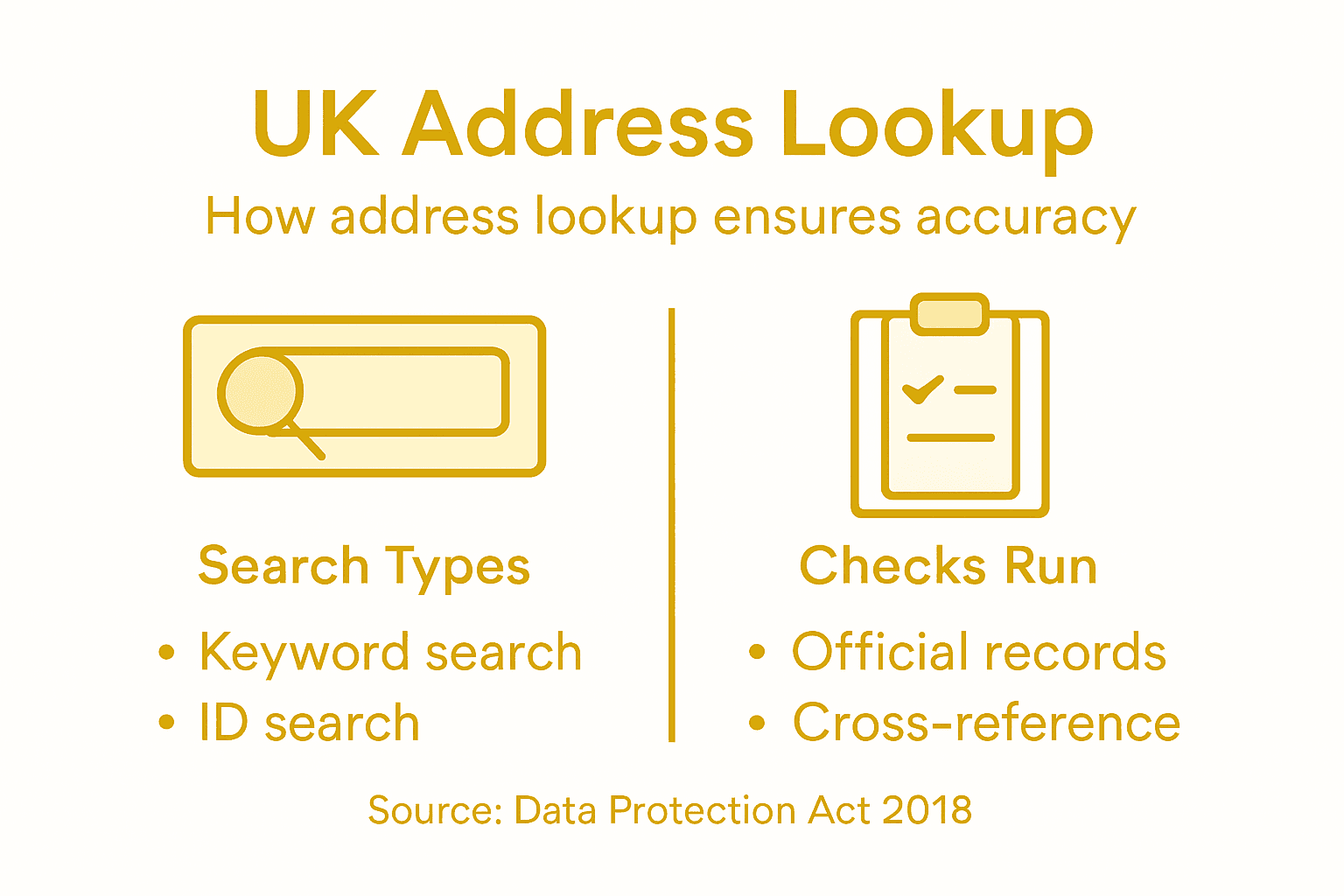
Understanding how address lookup actually functions helps you use it effectively. You’re not searching blindly or hoping for luck. You’re tapping into organized, verified data systems designed specifically for tracing and verification. The clearer your search criteria, the more precise your results will be.
Pro tip: Start your search with the most specific information you have, such as a full postcode rather than just a town name, to narrow results quickly and find the person you’re looking for faster.
Types of Address Searches and Key Differences
Not all address searches work the same way. When you’re trying to find someone in the UK, you have several options, and each one approaches the problem differently. Understanding these variations helps you choose the right method for what you’re trying to accomplish, whether that’s reconnecting with a lost relative or verifying someone’s current location.
The first major type is keyword-based searching. You enter partial information like a surname and street name, and the system searches for matches across available data. This approach offers flexibility when you have incomplete or uncertain details. However, it can return multiple results or miss matches due to spelling variations or name changes. This works well when you remember roughly where someone lived but lack specific address details.
The second type uses unique identifiers like postcodes and property reference numbers. Rather than guessing with keywords, you input exact codes or numbers that pinpoint specific locations. This method delivers precision and accuracy but requires you to know or obtain these specific identifiers first. If you have a postcode, this approach cuts through confusion instantly.
Hierarchical geographic searches represent the third approach. You start broad, selecting a region or town, then narrow down to streets and specific properties. This method suits situations where you know someone lived in a particular area but lack exact address details. It takes slightly longer but helps you visually navigate through possibilities.
Here’s how these differ in practice:
- Keyword searches work best when details are fuzzy or incomplete
- Identifier-based searches provide instant accuracy when you have specific codes
- Hierarchical searches help when you know the general area but need to find exact locations
- Keyword searches may require sorting through multiple results
- Identifier searches eliminate guesswork entirely
When tracing relatives, you often start with keyword searches using available information, then move to more specific identifier-based searches once you narrow down possibilities. This layered approach combines flexibility with precision, increasing your chances of finding the right person without wasting time on dead ends.
Here’s a quick comparison to help you choose the best address search method for your needs:
| Search Method | Best Use Case | Strengths | Limitations |
|---|---|---|---|
| Keyword Search | Limited or vague information | Flexible, accepts partial input | May return too many results |
| Identifier Search | Exact codes or reference numbers | Highly accurate, reliable matches | Requires specific knowledge |
| Hierarchical Search | Known area, missing details | Easy navigation by area | Can take longer to pinpoint |
Pro tip: When your initial keyword search returns too many results, refine your search by adding a postcode if available, or try switching to a reverse address lookup if you have even a partial address to work from.
Step-By-Step: How Address Lookup Works
Address lookup may seem like magic, but it’s actually a systematic process that happens behind the scenes. Understanding how it works helps you see why results are accurate and how to interpret what you find. Let’s walk through what happens from the moment you submit a search.
You start by entering your search criteria. This might be a postcode, a street name, a person’s surname, or a combination of details. The system receives this information and begins matching it against multiple databases. These databases contain official records, historical documents, and current property information maintained by government agencies and other authoritative sources.
The system then cross-references your search against these datasets. It’s looking for exact matches or close variations depending on your search type. If you searched by postcode, the system finds all addresses within that postcode. If you searched by name and street, it narrows down to matching records. This step is where most of the computational work happens.

Verification against official records comes next. The system checks your results against Unique Property Reference Numbers (UPRNs) and other authoritative identifiers. Each property in the UK has a unique UPRN, and matching your search results to these numbers ensures accuracy. This prevents errors from address variations, outdated street names, or inconsistent formatting.
The process then validates and confirms the data. The system checks whether the address is current, whether it’s been linked to specific occupants, and whether any address changes have occurred. This validation step catches discrepancies and ensures the information is reliable before presenting results to you.
Finally, the results are returned to you in an organized format. You see current addresses, historical resident information if available, and contact details when applicable. The entire process takes seconds, but it’s actually performing complex cross-referencing across vast datasets to deliver accurate information.
Here’s what makes this reliable: multiple data sources are checked simultaneously, results are validated against official identifiers, and the system catches address variations that manual searching would miss. When you see results, they’ve been verified multiple times over.
Pro tip: If your search returns no results initially, try adjusting your criteria by removing optional details like middle initials or trying alternate address spellings, as slight variations can prevent matches in the first attempt.
Legal Standards and Privacy Regulations in the UK
When you use an address lookup service in the UK, you’re protected by strict laws that govern how your personal information is handled. These regulations exist to prevent misuse and ensure that address data stays secure. Understanding what protections are in place gives you confidence that your search is conducted legally and ethically.
The foundation of UK privacy law is the Data Protection Act 2018, which incorporates the UK General Data Protection Regulation (GDPR). This law applies to any organization that collects, stores, or uses personal data, including address information. Whether you’re searching for a relative or verifying someone’s identity, the service provider must follow strict principles including lawfulness, fairness, and transparency. Data must be accurate, used only for legitimate purposes, and kept secure from unauthorized access.
These regulations aren’t just guidelines. They’re legal requirements with real consequences for violations. Organizations handling address data must obtain proper consent before using it, clearly explain what they’re doing with your information, and ensure it’s protected against breaches. If a service provider mishandles your data, they can face significant fines and legal action.
Your rights as a user matter too. You have the right to know what data is held about you, how it’s being used, and who has access to it. You can request corrections if information is inaccurate and can ask for your data to be deleted under certain circumstances. These rights exist specifically to protect you when address lookups or other data searches occur.
Why does this matter for your search? Reputable address lookup services comply fully with these regulations. They use data only for legitimate purposes like tracing lost relatives or verifying identities. They implement security measures, obtain necessary consents, and maintain clear records of who accessed your information and why.
When choosing an address lookup service, look for one that prioritizes these legal standards. Services that emphasize compliance and transparency are more trustworthy. They’re less likely to misuse your data or conduct searches inappropriately.
Pro tip: Before using any address lookup service, review their privacy policy to confirm they comply with UK data protection laws and explain how they’ll use your personal information during the search process.
Risks, Limitations, and Cost Considerations
Address lookup services are powerful tools, but they’re not without challenges. Understanding the risks and limitations helps you set realistic expectations and make informed decisions about which service to use. Cost considerations matter too, especially if you’re conducting multiple searches.
Data quality issues represent the primary limitation. Address databases can contain outdated information, duplicate entries, or incomplete records. Someone may have moved six months ago, but the database still shows their old address. Address entries might be recorded differently across systems, making searches inconsistent. These variations happen because address data comes from multiple sources that don’t always communicate or synchronize perfectly.
Security risks exist whenever personal data is accessed. Phishing scams and data breaches targeting address databases have occurred in the past. If an address lookup service has poor security practices, your search details or results could be exposed. This is why choosing a reputable, compliant service matters tremendously. Legitimate services invest heavily in encryption, access controls, and regular security audits.
Delay in data updates creates another limitation. Official records take time to process and integrate into databases. A person’s new address might not appear in the system for weeks or months after they move. Historical records may be incomplete, particularly for older addresses or properties with complex ownership histories. This means you might not find current information immediately.
Cost considerations vary depending on your needs. Basic searches on free tools offer limited information and slower results. Premium services charge per search or require subscriptions for multiple lookups. For someone tracing a single relative, costs might be minimal. For extensive genealogical research requiring dozens of searches, expenses add up quickly.
The trade-off is real: free services save money but may return incomplete or outdated results, while paid services offer greater accuracy and speed but require financial investment. Consider what you’re trying to accomplish and how many searches you’ll need.
To clarify how address lookup services differ by cost and coverage, here’s a helpful summary:
| Service Type | Average Cost per Search | Typical Data Depth | Update Frequency |
|---|---|---|---|
| Free Tool | No cost | Basic, limited accuracy | Infrequent updates |
| Premium Service | $5–$20 per search | Detailed, up-to-date data | Frequent updates |
| Subscription Plan | $30–$100 monthly | Bulk access, historical data | Regular automatic updates |
Pro tip: Start with a free search to test availability, then upgrade to a premium service only if you need faster results or more detailed information, rather than purchasing immediately.
Ensure Accurate UK Address Lookups with Expert Help
When you need to verify someone’s current location or trace lost relatives, accuracy and reliability are essential. This article highlights the challenges of outdated data, multiple search methods, and strict privacy rules that can complicate address lookup processes. At UKtrace.co.uk, we understand these pain points and provide specialized electronic tracing solutions designed to deliver precise and legally compliant results. Whether you require a reverse address search or identity verification, we help you navigate complex databases efficiently.
Take control of your search now by exploring our Name and address searches UK for flexible, keyword-based and identifier-driven lookups. If your inquiry extends to property details or historical occupants, our UK Land and property searches give you deeper insights. Visit UKtrace.co.uk today and experience a confidential, user-focused service that transforms uncertainty into clarity. Don’t let incomplete or incorrect information hold you back—start your precise UK address lookup with us immediately.
Frequently Asked Questions
What is address lookup?
Address lookup is the process of identifying and verifying specific location details using official records and data sources. It allows users to find individuals by their addresses rather than names, confirming residency and identity through cross-referencing multiple databases.
How does address lookup ensure accuracy?
Address lookup ensures accuracy by cross-referencing search criteria against multiple authoritative databases, including historical records and current property information. The system verifies results against unique identifiers, such as Unique Property Reference Numbers (UPRNs), to confirm data reliability.
What types of address searches are available?
There are three main types of address searches: keyword-based searches, which use partial information; identifier-based searches, which rely on specific codes like postcodes; and hierarchical searches, which allow users to narrow down results based on broader geographic areas before pinpointing exact locations.
Are there legal protections governing address lookup services?
Yes, address lookup services in the UK are governed by strict laws, including the Data Protection Act 2018, which ensures personal data is handled lawfully and securely. Users have rights regarding their data, including access, correction, and deletion requests.