
Searching for lost family members or trying to confirm someone’s identity in the United Kingdom often feels like solving a puzzle with hundreds of missing pieces. The need to reconnect or uncover ancestry can become deeply personal, especially when details are hard to find. Professional person trace services use systematic and legally compliant methods to boost the chances of success far beyond casual online searches, offering structured support for those hoping to find important answers about their past.
Table of Contents
- Defining Person Trace and Its Purpose
- Common Reasons for Using Person Trace Services
- Types of Person Trace Solutions Available
- Legal and Privacy Issues in the UK
- Risks, Costs, and Service Limitations
Key Takeaways
| Point | Details |
|---|---|
| Purpose of Person Trace Services | These services are crucial for reconnecting with lost family members, verifying identities, and supporting legal processes in the UK. |
| Professional vs. Casual Searches | Professional person trace services utilize sophisticated methods and databases for higher success rates compared to casual internet searches. |
| Legal Compliance | Tracing services must adhere to strict data protection laws and obtain consent while ensuring privacy is maintained. |
| Risks and Considerations | Potential clients should be aware of data inaccuracies, varying costs, and the limitations of the investigation when using these services. |
Defining Person Trace and Its Purpose
Person trace is a specialized investigative service designed to help individuals locate and identify people within the United Kingdom through systematic information gathering. This process involves searching public records, databases, and other legal information sources to connect individuals who are seeking to find someone specific.
The purpose of person trace services extends beyond simple curiosity. Official government guidance on family tracing indicates these services can be crucial for several important scenarios:
- Reconnecting with lost family members
- Verifying personal identities
- Locating potential heirs or beneficiaries
- Conducting genealogical research
- Supporting legal and administrative processes
Person trace professionals utilize a combination of advanced digital search techniques and access to comprehensive databases to track down individuals. These searches might involve cross-referencing multiple sources like electoral registers, credit history, utility records, and other publicly accessible information repositories. The goal is to provide accurate, current contact details or location information while maintaining strict legal and ethical standards of privacy protection.
Unlike casual internet searches, professional person trace services offer structured, systematic approaches that significantly increase the likelihood of successfully locating the desired individual. They employ specialized techniques that go well beyond basic online search methods, accessing resources not readily available to the general public.
Pro tip: When initiating a person trace, gather as much preliminary information as possible about the individual, including last known location, age, and any identifying details to improve search accuracy.
Common Reasons for Using Person Trace Services
Person trace services address a wide range of critical personal and professional needs in the United Kingdom. Tracing individuals in the UK involves complex processes that help individuals and organizations resolve various challenging situations where locating a specific person becomes essential.
The most common reasons for utilizing person trace services include:
- Legal Document Service: Serving legal notices or court summons to individuals who cannot be easily contacted
- Debt Recovery: Tracking down individuals who owe financial obligations
- Inheritance and Estate Matters: Locating potential heirs or beneficiaries
- Genealogical Research: Reconnecting with long-lost family members
- Background Verification: Conducting comprehensive identity checks
Professional tracing services are particularly valuable in scenarios where traditional communication methods have failed. For instance, businesses seeking to recover outstanding debts or law firms requiring precise location information for legal proceedings rely on these specialized search techniques. These services employ advanced digital investigation methods that go beyond basic online searches, accessing comprehensive databases and cross-referencing multiple information sources.
Private individuals also frequently use person trace services for personal reconciliation. Whether attempting to reconnect with estranged family members, locate childhood friends, or understand complex family histories, these services provide a structured and legal approach to finding individuals who might otherwise remain untraceable.

Pro tip: Always collect and document as much preliminary information as possible about the person you are trying to locate, including their last known address, age, and any identifying details to increase the accuracy of your search.
Types of Person Trace Solutions Available
Person trace solutions in the United Kingdom are diverse and sophisticated, offering multiple approaches to locating individuals through systematic investigative techniques. These solutions range from digital searches to comprehensive professional investigation services, each designed to address specific tracing requirements.
The primary types of person trace solutions include:
- Digital Database Search: Utilizing comprehensive online public records
- Social Media Investigation: Tracking digital footprints and online presence
- Electoral Roll Verification: Checking official residential registration records
- Professional Tracing Services: Comprehensive investigative approaches with advanced research techniques
- Skip Tracing: Specialized searching for individuals who have deliberately moved or hidden their location
Digital trace solutions leverage multiple data sources, combining technological tools with investigative expertise. These methods might include cross-referencing social media profiles, analyzing public records, examining credit reports, and accessing specialized databases that are not typically available to the general public. Professional tracers use sophisticated algorithms and access to restricted information networks to compile detailed personal profiles.
For individuals and organizations requiring precise location information, these trace solutions offer graduated levels of service. Some providers offer basic online searches, while others provide in-depth investigations that include physical surveillance, comprehensive background checks, and advanced tracking methodologies. The complexity and depth of the search can be tailored to specific client needs, ranging from simple contact information retrieval to comprehensive personal history investigations.
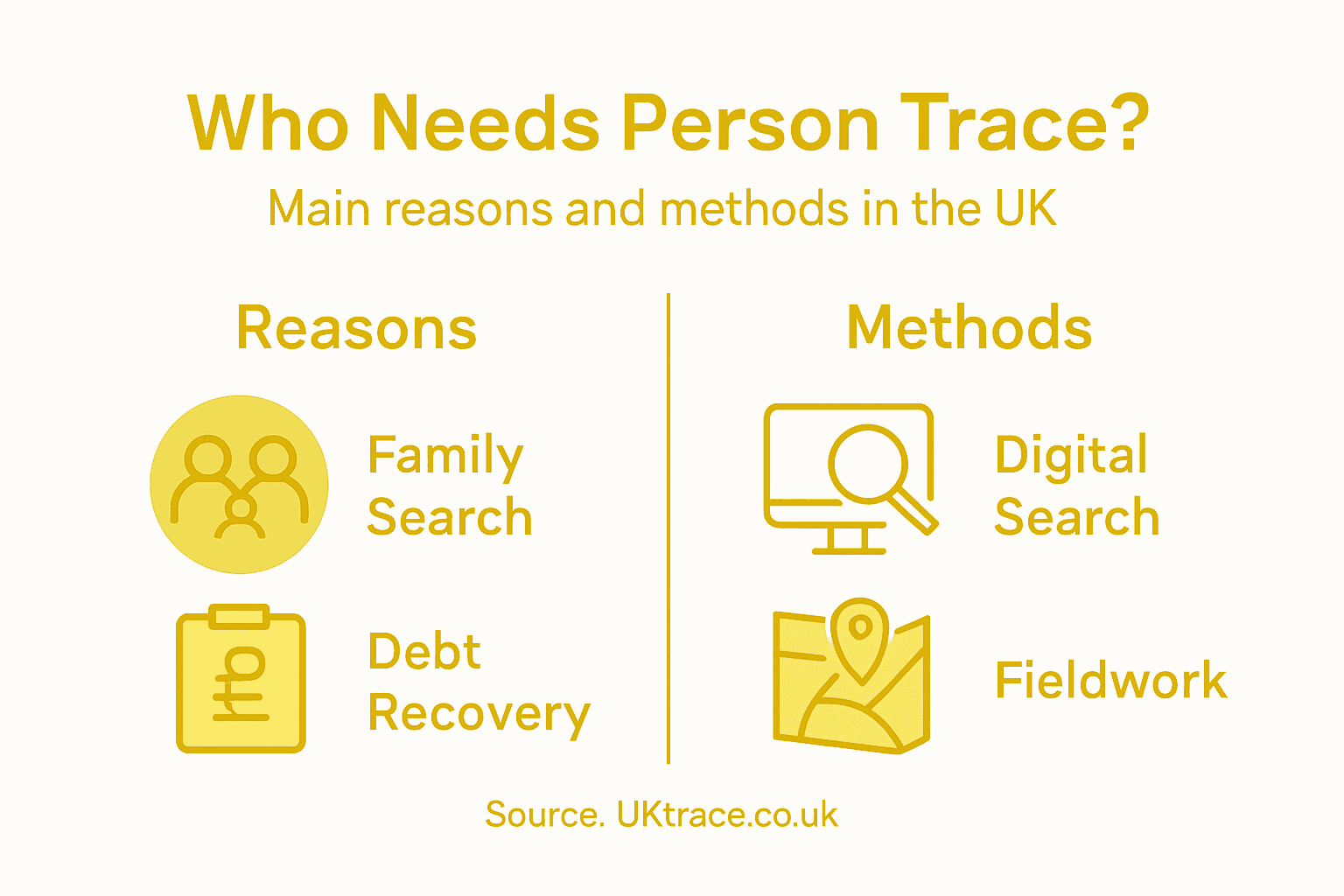
Here is a summary comparison of common person trace methods and their unique strengths:
| Method | Best For | Data Sources Accessed | Limitations |
|---|---|---|---|
| Digital Database Search | Quick contact information | Public records, databases | Limited to available data |
| Social Media Investigation | Online presence verification | Social platforms, posts | Incomplete if profiles private |
| Electoral Roll Verification | Residency confirmation | Electoral registers | Requires up-to-date records |
| Professional Tracing Services | In-depth investigation | Restricted databases, fieldwork | Higher cost, legal requirements |
| Skip Tracing | Deliberately hidden locations | Credit info, utility records | May still be unsuccessful |
Pro tip: When selecting a person trace service, carefully assess the legal and ethical standards of the provider, ensuring they comply with data protection regulations and maintain strict confidentiality.
Legal and Privacy Issues in the UK
Person trace services in the United Kingdom must navigate a complex legal landscape governed by stringent data protection regulations. Data protection legislation establishes critical frameworks that balance the need for information retrieval with individual privacy rights.
The key legal considerations for person trace services include:
- Consent Requirements: Obtaining explicit permission for data processing
- Data Minimization: Collecting only necessary personal information
- Purpose Limitation: Using data exclusively for intended tracing purposes
- Transparency: Clearly communicating how personal data will be used
- Individual Rights: Protecting the subject’s right to privacy and data access
Under the UK Data Protection Act and General Data Protection Regulation (GDPR), tracing services must demonstrate legitimate grounds for accessing and processing personal information. This means they cannot simply collect or share data without a valid legal basis. Legitimate interests might include legal proceedings, debt recovery, or family reunification, but each case requires careful assessment of privacy implications.
Professional tracing organizations must implement robust safeguards to protect sensitive personal information. This involves secure data storage, limited access protocols, and strict verification processes to prevent unauthorized use of personal details. Failure to comply with these regulations can result in significant financial penalties and legal consequences, making rigorous data protection a critical aspect of person trace services.
Pro tip: Always request a comprehensive privacy policy and data handling statement from any person trace service to ensure they meet legal standards and protect your personal information.
Risks, Costs, and Service Limitations
Person trace services involve complex considerations that potential clients must carefully evaluate. Tracing services carry inherent risks that extend beyond simple information retrieval, requiring a nuanced understanding of potential challenges and limitations.
Key risks and potential complications include:
- Data Inaccuracy: Potential for outdated or incorrect information
- Privacy Violations: Risk of breaching legal data protection standards
- Incomplete Traces: Possibility of unsuccessful location attempts
- Financial Uncertainty: Varying cost structures and unpredictable outcomes
- Ethical Considerations: Potential intrusion into personal boundaries
Cost structures for person trace services typically range from fixed-rate packages to contingency-based pricing models. Some providers charge flat fees for basic searches, while more comprehensive investigations might involve tiered pricing based on the complexity of the trace. Clients should expect costs to vary significantly depending on the depth of investigation required, with simple online searches being considerably less expensive than detailed background investigations.
Service limitations are primarily defined by legal restrictions and available data sources. Professional tracing services cannot circumvent data protection laws, which means they are constrained by strict guidelines about information access and usage. This means that not all traces will be successful, and the depth of information retrieved can be limited by legal and ethical considerations. Factors such as the age of the target individual, length of time since last known contact, and available public records can significantly impact the effectiveness of a trace.
The following table outlines key cost factors and risks associated with person trace services:
| Factor | Impact on Client Experience | Typical Variability |
|---|---|---|
| Service Fee Structure | Determines initial investment | Fixed or tiered rates |
| Data Accuracy | Influences trace reliability | May vary by provider |
| Legal Compliance | Protects personal rights | Mandatory for all services |
| Investigation Depth | Defines detail of results | Basic to comprehensive |
| Privacy Risk | Ensures confidential handling | Varies by protocols |
Pro tip: Always request a detailed breakdown of potential costs and success rates before commissioning a person trace service, and ensure you understand the specific limitations of the investigation.
Discover Reliable Person Trace Solutions Tailored for You
If locating someone in the UK feels overwhelming due to privacy rules and incomplete data, you are not alone. Many individuals and businesses face the challenge of finding accurate and up-to-date contact details or verifying identities as outlined in the article. Whether the goal is reconnecting with lost family members, assisting with legal matters, or verifying personal information, precision and confidentiality remain paramount. UK Trace understands these pain points and offers specialized services designed to deliver trustworthy results through Name and address searches UK and Birth, Marriage and Death searches.
Take control of your person trace needs today with UKtrace.co.uk. Our electronic tracing solutions combine extensive UK databases and investigative expertise to ensure you receive the detailed information required for personal or professional purposes. Do not let time or data restrictions hold you back. Visit UKtrace.co.uk now to begin a confidential and accurate search that puts trusted information within your reach.
Frequently Asked Questions
Who typically needs person trace services?
Individuals and organizations often need person trace services for various reasons, including reconnecting with lost family members, verifying identities, locating beneficiaries for inheritance, conducting genealogical research, and serving legal documents to hard-to-find individuals.
What are the main methods used in professional person tracing?
Professional person tracing typically involves several methods, including digital database searches, social media investigations, electoral roll verification, skip tracing, and comprehensive investigative services that combine various data sources and techniques.
How do person trace services ensure compliance with privacy laws?
Person trace services in the UK must adhere to strict data protection regulations. This includes obtaining consent for data processing, minimizing the data collected, using it only for outlined purposes, and maintaining transparency about how personal information is handled.
What are the risks associated with using person trace services?
Using person trace services carries risks such as possible data inaccuracies, privacy violations, incomplete searches, variable costs, and ethical concerns regarding personal boundaries. Clients should ensure they understand these risks before engaging in such services.
Recommended
- Skip Trace - Get current address – UK Trace
- Trace a person UK - by name, mobile number, address, date of birth – UK Trace
- Address Find Uk - Address Search – UK Trace
- Find Someone’s address. Address Finder in the UK - best ways – UK Trace
- Where Can I Find a Property Solicitor for Urgent Conveyancing in the UK? - Kefihub