
Locating a loved one or verifying an identity can feel daunting when privacy and accuracy matter most. In the United Kingdom, tracing people is more than searching public records—it requires navigating strict legal frameworks and respecting sensitive information. This guide dispels common myths, highlights the importance of lawful and ethical tracing, and outlines how professional services reconnect families or support legal investigations with confidentiality and trust.
Table of Contents
- Defining People Tracing And Common Myths
- Main Types Of People Tracing Services
- How People Tracing Works In The UK
- Legal Framework And Privacy Requirements
- Risks, Mistakes, And Ethical Concerns
Key Takeaways
| Point | Details |
|---|---|
| Understanding People Tracing | People tracing is a legal and ethical process used to locate individuals using authorized information and investigative techniques. |
| Myths vs. Reality | Contrary to common myths, people tracing is not illegal or unethical, nor does it always incur high costs. |
| Types of Services | Various people tracing services cater to specific needs, including genealogical and humanitarian tracing, among others. |
| Ethical Considerations | Ethical practices in people tracing prioritize individual privacy, informed consent, and the protection of vulnerable populations. |
Defining people tracing and common myths
People tracing is a systematic process of locating individuals using various investigative techniques and data sources. At its core, this service helps reconnect people, verify identities, and gather critical information about an individual’s current whereabouts or contact details.
Contrary to popular misconceptions, people tracing is not about invasive surveillance or stalking. Instead, it involves legally and ethically accessing public and authorized information databases to help individuals and organizations find specific persons. Tracing UK addresses requires careful navigation through privacy regulations and data protection guidelines.
Common myths about people tracing include:
- Myth: People tracing is illegal or unethical
- Reality: Professional tracing services follow strict legal frameworks
- Myth: Anyone can access personal information freely
- Reality: Legitimate tracing requires specific authorization and permissions
- Myth: Tracing always involves high costs
- Reality: Many services offer affordable and targeted search options
People tracing serves multiple legitimate purposes, such as:
- Locating long-lost family members
- Verifying potential business partners
- Conducting background checks
- Supporting legal investigations
- Reuniting separated individuals
Professional tracing services utilize advanced search techniques, cross-referencing multiple databases, and employing sophisticated algorithms to generate accurate results. These methods go far beyond simple internet searches, providing comprehensive and reliable information.
Pro tip: Always verify the credibility and legal compliance of any people tracing service before engaging their assistance.
Main types of people tracing services
People tracing services encompass a diverse range of specialized approaches designed to locate and reconnect individuals across various contexts. These services are carefully tailored to meet different investigative needs, ranging from personal reunification to professional background verification.

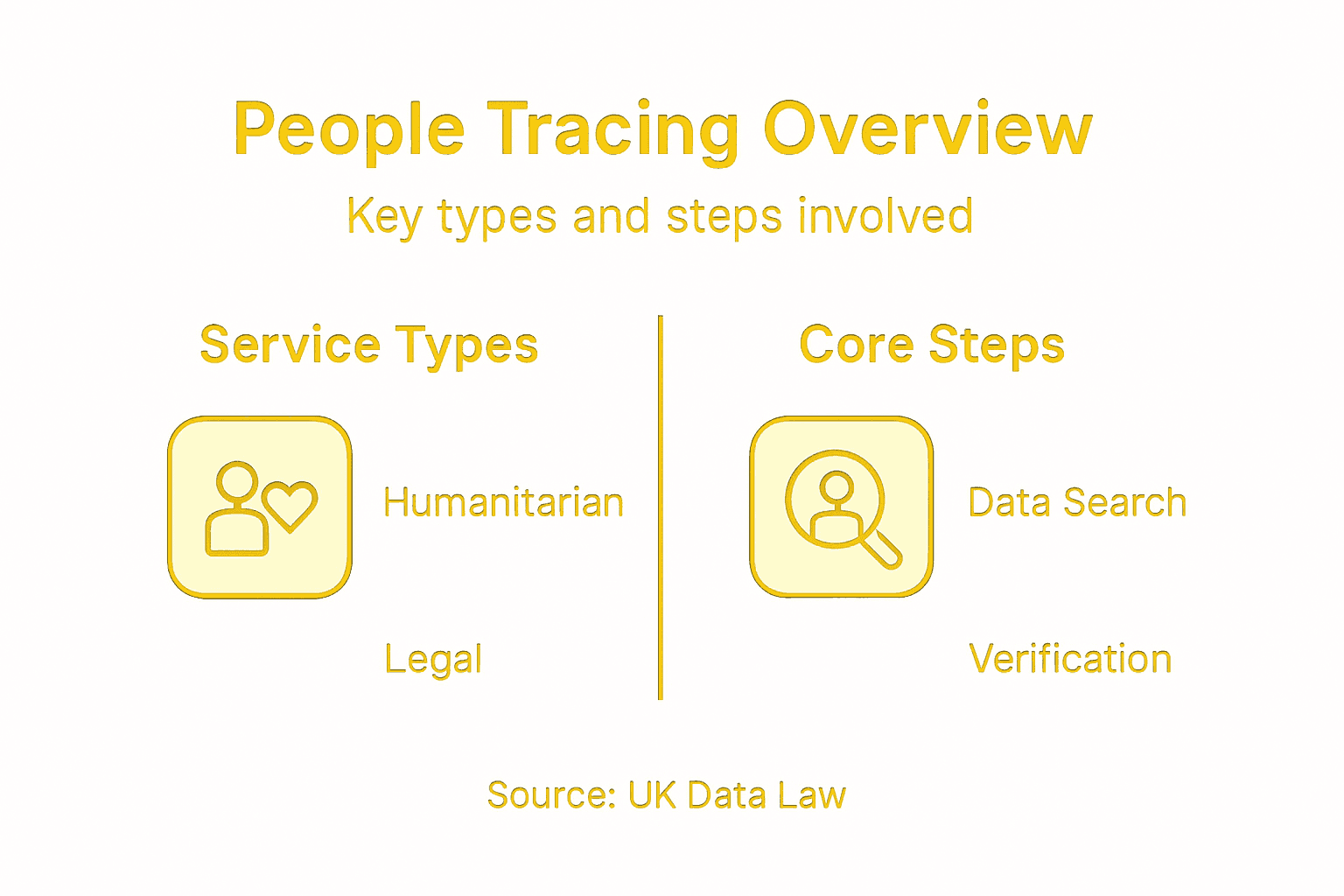
Humanitarian tracing represents a critical category, particularly in challenging scenarios. Tracing and registration efforts by international organizations like the Red Cross focus on reuniting families separated by conflicts, natural disasters, or migration challenges. These services often involve complex cross-border investigations and digital humanitarian platforms.
The primary types of people tracing services include:
Here is a comparison of main types of people tracing services and their typical beneficiaries:
| Tracing Service Type | Primary Beneficiary | Common Context |
|---|---|---|
| Genealogical Tracing | Individuals & families | Family history research |
| Debt Recovery Tracing | Businesses & financial firms | Locating debt defaulters |
| Legal Investigations | Lawyers & court officials | Finding witnesses or parties |
| Missing Persons Searches | Law enforcement & families | Locating at-risk individuals |
| Humanitarian Tracing | NGOs & international agencies | Crisis and disaster reunions |
| Background Verification | Employers & relationship seekers | Employment or trust checks |
- Genealogical Tracing: Helping individuals research family history and locate distant relatives
- Debt Recovery Tracing: Assisting businesses in locating individuals with outstanding financial obligations
- Legal Investigations: Supporting legal professionals in finding witnesses or parties to legal proceedings
- Missing Persons Searches: Collaborating with law enforcement to locate missing individuals
- Background Verification: Conducting comprehensive checks for employment or personal relationship assessments
Each tracing service employs unique methodological approaches:
- Public Record Searches
- Database Cross-Referencing
- Social Media Intelligence
- Network and Relationship Mapping
- Advanced Digital Investigation Techniques
Professional tracing services utilize sophisticated algorithms and comprehensive data sources to generate accurate and legally compliant results. These methods combine technological tools with expert human analysis to maximize search effectiveness.
Pro tip: Always ensure the tracing service you choose operates within strict legal and ethical boundaries, protecting individual privacy rights.
How people tracing works in the UK
People tracing in the United Kingdom operates within a complex legal and technological framework designed to protect individual privacy while enabling legitimate search processes. The methodology involves multiple interconnected strategies that leverage both digital and traditional investigative techniques.
The primary investigation process begins with comprehensive data collection from multiple authorized sources. Tracing UK addresses requires navigating strict data protection regulations, ensuring that all searches comply with the General Data Protection Regulation (GDPR) and Data Protection Act 2018. Investigators utilize a multi-step approach to locate individuals:
Key data sources for people tracing include:
- Electoral Roll Records
- Credit Reference Agency Databases
- Council Tax Registration Information
- Utility Company Records
- National Insurance Registration Systems
- Driver and Vehicle Licensing Agency (DVLA) Records
The typical people tracing workflow involves several critical stages:
- Initial Information Gathering
- Database Cross-Referencing
- Digital Network Analysis
- Verification of Located Information
- Confidential Reporting
Advanced technological tools play a crucial role in modern people tracing, incorporating sophisticated algorithms that can quickly analyze vast amounts of data. These systems combine machine learning techniques with expert human verification to enhance accuracy and reliability.
Pro tip: Request a comprehensive privacy impact assessment before initiating any people tracing investigation to ensure full legal compliance and protect individual rights.
Legal framework and privacy requirements
Data protection in the United Kingdom represents a sophisticated legal ecosystem designed to safeguard individual privacy while enabling responsible information processing. The intricate regulatory landscape ensures that personal information remains protected through comprehensive legislative mechanisms.
Data protection regulations in the UK are primarily governed by two critical legal frameworks: the UK General Data Protection Regulation (UK GDPR) and the Data Protection Act 2018. These regulations establish strict guidelines for how personal information can be collected, processed, and utilized across various investigative contexts.
Key privacy protection principles include:
The following table summarizes key privacy protection principles and their practical outcomes:
| Principle | Practical Outcome |
|---|---|
| Lawful data processing | Personal data handled with explicit legal basis |
| Purpose limitation | Data used only for declared reasons |
| Data minimization | Only necessary details are collected |
| Accuracy and currency | Information remains up to date and correct |
| Robust security measures | Data remains protected from breaches |
| Rights of access & change | Individuals can view or amend their data |
- Lawful and transparent data processing
- Purpose limitation for data collection
- Minimization of personal data usage
- Ensuring data accuracy and currency
- Implementing robust security measures
- Protecting individual rights of access and modification
Specific legal requirements for people tracing services involve:
- Obtaining explicit consent for data processing
- Maintaining comprehensive documentation of search processes
- Implementing secure data storage protocols
- Restricting data access to authorized personnel
- Providing clear mechanisms for individual data rights
Sensitive personal data receives heightened protection, with additional restrictions surrounding information related to ethnicity, religious beliefs, health status, and other potentially vulnerable categories. Tracing services must navigate these regulations with exceptional care and precision.
Unauthorized disclosure or misuse of personal information can result in significant legal penalties, including substantial financial fines and potential criminal prosecution.
Pro tip: Always request a detailed privacy impact assessment and ensure full compliance with current data protection regulations before initiating any investigative process.
Risks, mistakes, and ethical concerns
People tracing involves complex ethical challenges that extend far beyond simple data retrieval. The potential for misuse and unintended consequences demands rigorous safeguards and professional accountability to protect individual privacy and personal safety.
Data protection practices reveal significant risks in tracing services, particularly concerning vulnerable populations. Potential ethical risks include:
- Unauthorized information disclosure
- Potential harassment of vulnerable individuals
- Misuse of personal data by malicious actors
- Breaching confidentiality agreements
- Exposing individuals to potentially dangerous situations
- Violating individual consent and autonomy
Critical ethical considerations for responsible people tracing involve:
- Obtaining verifiable informed consent
- Protecting individual anonymity
- Preventing potential abuse scenarios
- Maintaining strict confidentiality standards
- Implementing robust verification processes
Vulnerable populations require exceptional protection during tracing investigations. Domestic abuse survivors, individuals in potentially dangerous personal situations, and those with sensitive personal histories demand heightened ethical scrutiny and professional discretion.
Ethical investigations prioritize individual safety and privacy over investigative outcomes, recognizing that human dignity supersedes information retrieval.
Pro tip: Always conduct a comprehensive risk assessment and establish clear ethical boundaries before initiating any people tracing investigation.
Discover Reliable People Tracing Solutions with UKtrace.co.uk
When trying to locate loved ones, verify identities, or gather crucial contact details, navigating legal restrictions and data privacy can feel overwhelming. The article’s focus on ethical, accurate, and GDPR-compliant people tracing highlights the challenge of accessing trustworthy information without risking privacy breaches or misinformation. Key pain points include the need for confidential handling, thorough verification, and clear legal compliance to avoid misuse or unauthorized data disclosure.
At UKtrace.co.uk, we specialize in delivering precise and confidential Name and address searches UK that cater to both personal and professional needs. Our expert electronic tracing service employs advanced investigative methods aligned with UK data protection laws to provide you with accurate information—whether you are looking for lost relatives, verifying identities, or seeking address history.
Take control of your people tracing challenges today by choosing a service dedicated to confidentiality and compliance. Visit UKtrace.co.uk now and explore how our comprehensive Name and address searches UK and complementary Birth, Marriage and Death searches empower you with reliable data while respecting legal boundaries. Act now to access trustworthy information with confidence.
Frequently Asked Questions
What is people tracing?
People tracing is a systematic process used to locate individuals through various investigative techniques and data sources, focusing on reconnecting people and gathering information about their whereabouts.
Is people tracing legal and ethical?
Yes, professional people tracing services operate within strict legal frameworks and comply with ethical guidelines, using authorized information sources to find individuals without invasive practices.
What are the common purposes of people tracing?
People tracing is used for various legitimate purposes, including locating long-lost family members, verifying business partners, conducting background checks, and supporting legal investigations.
How does people tracing work?
The process involves comprehensive data collection from multiple authorized sources, database cross-referencing, digital network analysis, and verification of information, all while adhering to data protection regulations.