
Trying to piece together a loved one’s past or confirm someone’s identity often comes down to one detail—their address history. The need for accurate residential data drives many in the United Kingdom to seek reliable reverse address search methods when traditional searches fall short. This guide explains how professional address matching works, what information can be uncovered, and what privacy laws shape access so you can move forward with confidence.
Table of Contents
- Reverse Address Search Defined And Debunked
- Common Variations And Trace Methods In The UK
- How Professional Reverse Search Services Work
- Legal Regulations, Privacy, And Consent
- Risks, Cost, And Mistakes To Avoid
Key Takeaways
| Point | Details |
|---|---|
| Reverse Address Search Defined | A reverse address search reveals information about current and prior residents of a specific property in the United Kingdom, aiding in understanding residential history and verifying occupancy. |
| Complex Methodologies | Successful address searches combine various data sources and advanced techniques to ensure accuracy, such as cross-referencing government and private databases. |
| Legal and Privacy Considerations | These searches operate under strict legal regulations that require consent and data protection, ensuring personal information is handled responsibly. |
| Cost and Service Selection | Choosing a reputable service is crucial to avoid outdated or inaccurate information, highlighting the importance of thorough evaluations and transparent pricing. |
Reverse Address Search Defined and Debunked
A reverse address search enables individuals to uncover critical details about a specific property location in the United Kingdom by investigating who currently resides or has previously inhabited that address. This investigative technique allows users to trace residential history, verify occupancy, and gather essential contact information without direct interaction with current residents.
The process of reverse address searching involves several sophisticated data retrieval methods. Address matching services utilize advanced technological approaches to parse and standardize address information across multiple databases. These techniques ensure accuracy and reliability when connecting residential data points.
Key characteristics of effective reverse address searches include:
- Accessing comprehensive property records
- Cross-referencing multiple government and private databases
- Protecting individual privacy while providing essential information
- Delivering precise and current residential details
While reverse address searches can provide valuable insights, it’s crucial to understand their limitations. Not all searches guarantee complete information, and legal restrictions protect certain personal data. Reliable services focus on delivering verified, ethical information that respects individual privacy rights.
Pro tip: Always verify the legitimacy of the reverse address search service and understand the legal boundaries of information retrieval before proceeding with any investigation.
Common Variations and Trace Methods in the UK
Reverse address searches in the United Kingdom encompass multiple sophisticated techniques for uncovering residential information. Address tracing involves complex methodologies that go beyond simple database queries, requiring advanced technological approaches to verify and connect residential data points across various sources.
Property reference systems play a crucial role in creating accurate address search frameworks. These systems enable researchers to access comprehensive databases that link specific locations with historical and current occupancy information, ensuring precise and reliable investigative results.
Common trace methods in the UK include:
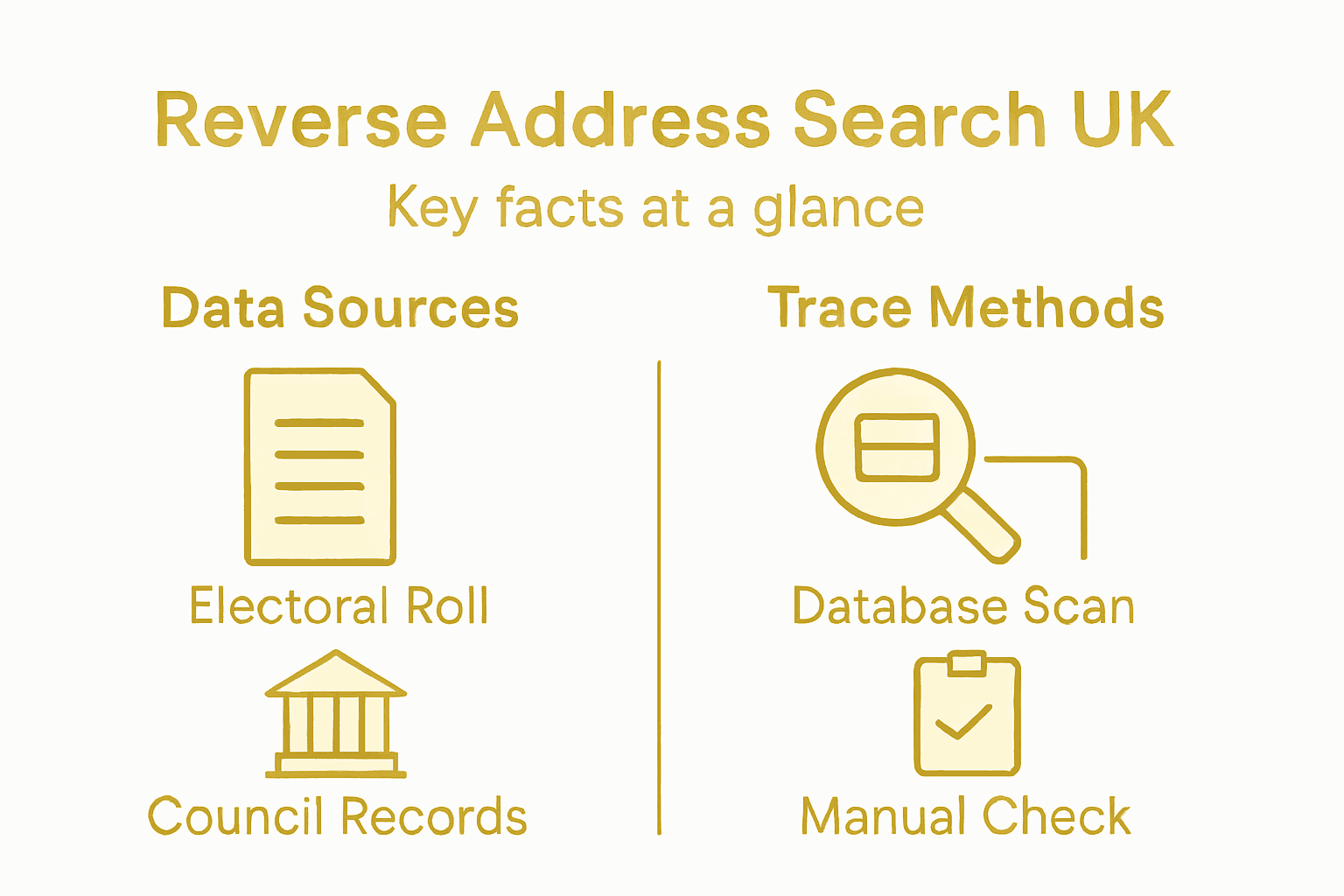
- Electoral roll cross-referencing
- Council tax registration records
- Utility bill connection databases
- Credit reference agency information
- Postal redirection service records
Each trace method has unique strengths and limitations. Successful address searches require combining multiple data sources to create a comprehensive picture of residential history. Professional services specialize in navigating these complex information networks, ensuring both accuracy and legal compliance when retrieving address-related details.
Here’s a comparison of major data sources used in UK reverse address searches and how each contributes to investigations:
| Data Source | Type of Information Provided | Strengths | Drawbacks |
|---|---|---|---|
| Electoral Roll | Current and recent residents | Publicly available records | May be outdated |
| Council Tax Records | Property occupancy, tax status | Official government data | Not always publicly shared |
| Utility Bill Databases | Service connections, occupancy | Confirms move-in/move-out | Access restrictions |
| Credit Reference Agency | Address and credit file linking | Comprehensive history | Strong privacy controls |
| Postal Redirection Records | Changes of address, recent moves | Detects recent relocations | Limited to redirected mail |
Pro tip: Always verify the credibility of your information source and understand the legal restrictions surrounding personal data retrieval before conducting any address trace.
How Professional Reverse Search Services Work
Professional reverse address search services employ sophisticated methodologies to retrieve accurate residential information across the United Kingdom. These specialized investigative platforms leverage complex data aggregation techniques that go far beyond simple online searches, providing comprehensive and legally compliant results for individuals and organizations.
Address matching technologies form the critical backbone of professional tracing services. These advanced systems utilize sophisticated data science approaches that include:
- Parsing complex address formats
- Cross-referencing multiple governmental and private databases
- Real-time verification of residential information
- Scoring and ranking potential matches
- Ensuring data privacy and legal compliance
The process of professional reverse address searching involves intricate steps designed to protect individual privacy while delivering precise information. Investigators use multilayered verification protocols that combine digital records, historical databases, and authorized information sources to generate reliable residential traces. This approach ensures accuracy and minimizes the potential for incorrect or outdated information.

Pro tip: Always request a comprehensive report that details the methodology and sources used in your address search to understand the depth and reliability of the investigation.
Legal Regulations, Privacy, and Consent
Reverse address searches in the United Kingdom operate within a complex legal framework designed to protect individual privacy while enabling legitimate information retrieval. The intricate balance between access to information and personal data protection requires strict adherence to comprehensive regulatory standards.
Data protection regulations establish critical guidelines for personal information processing. These legal requirements mandate that reverse address search services must:
- Obtain explicit or implied consent
- Demonstrate legitimate business interest
- Maintain data accuracy and relevance
- Implement robust security measures
- Provide transparent information about data usage
- Allow individuals to request data modification or deletion
Professional reverse address search providers must navigate a complex landscape of legal considerations. Organizations are required to implement multilayered consent mechanisms that clearly communicate how personal information will be collected, processed, and protected. This approach ensures that individuals maintain control over their personal data while allowing for necessary investigative processes.
Pro tip: Always request a detailed privacy policy that explicitly outlines how your personal information will be used, stored, and protected during the reverse address search process.
Risks, Cost, and Mistakes to Avoid
Reverse address searches can be powerful investigative tools, but they come with potential pitfalls that require careful navigation. Information accuracy depends on selecting reputable services and understanding the limitations of different search methodologies.
Common risks associated with reverse address searches include:
- Obtaining outdated or incorrect residential information
- Potential privacy violations
- Unexpected financial costs
- Misinterpreting search results
- Encountering incomplete or fragmented data
- Potential legal complications from improper information use
Address tracing services require a strategic approach to minimize financial and informational risks. Users should carefully evaluate service providers, understanding that the cheapest option is rarely the most comprehensive or accurate. Professional services typically offer tiered pricing models that reflect the depth and reliability of their investigative processes.
Pro tip: Request sample reports and verify the service’s data verification processes before committing to any reverse address search to ensure you receive accurate and reliable information.
To help you select a trustworthy reverse address search provider, here is a summary of key factors and their importance:
| Factor | Why It Matters | What to Look For |
|---|---|---|
| Data Verification | Ensures information accuracy | Detailed methodology |
| Privacy Protection | Safeguards personal data | Clear privacy policy |
| Legal Compliance | Avoids legal risks | Compliance statements |
| Pricing Transparency | Prevents unexpected costs | Upfront fee disclosure |
| Report Detail | Supports confident decisions | Sample reports provided |
Unlock the Power of Reverse Address Search with UKtrace.co.uk
If you are struggling to reconnect with past or current occupants of a property or need to verify important address details, reverse address searches provide a vital solution. The article highlights common challenges such as locating up-to-date residency records, ensuring data accuracy, and maintaining privacy while navigating complex legal frameworks. At UKtrace.co.uk, we understand these pain points and specialize in delivering reliable, confidential, and comprehensive name and address search services tailored to your needs.
Discover how our professional investigative techniques combine multiple data sources to provide you with actionable information. Whether you are conducting ancestry research, verifying an identity, or trying to find lost relatives, our Name and address searches UK offer precise and legally compliant solutions you can trust.
Take control of your investigation today with UKtrace.co.uk. Access detailed reports and expert support to navigate the complexities of reverse address searches. Visit our homepage at UKtrace.co.uk and explore additional services like UK Land and property searches to enhance your research. Act now to obtain accurate, confidential information that bridges gaps and reconnects you with important contacts.
Frequently Asked Questions
What is a reverse address search?
A reverse address search allows individuals to find critical information about a specific property or its residents by investigating the current and previous inhabitants of that address.
How does the reverse address search process work?
The process typically involves accessing comprehensive property records and cross-referencing multiple databases to gather residential history and verify occupancy.
What data sources are commonly used in reverse address searches?
Common data sources include electoral rolls, council tax records, utility bill databases, credit reference agency information, and postal redirection service records.
Are there legal restrictions on reverse address searches?
Yes, reverse address searches operate under stringent legal regulations that protect individual privacy and personal data. Services must adhere to guidelines ensuring consent and privacy protection.